




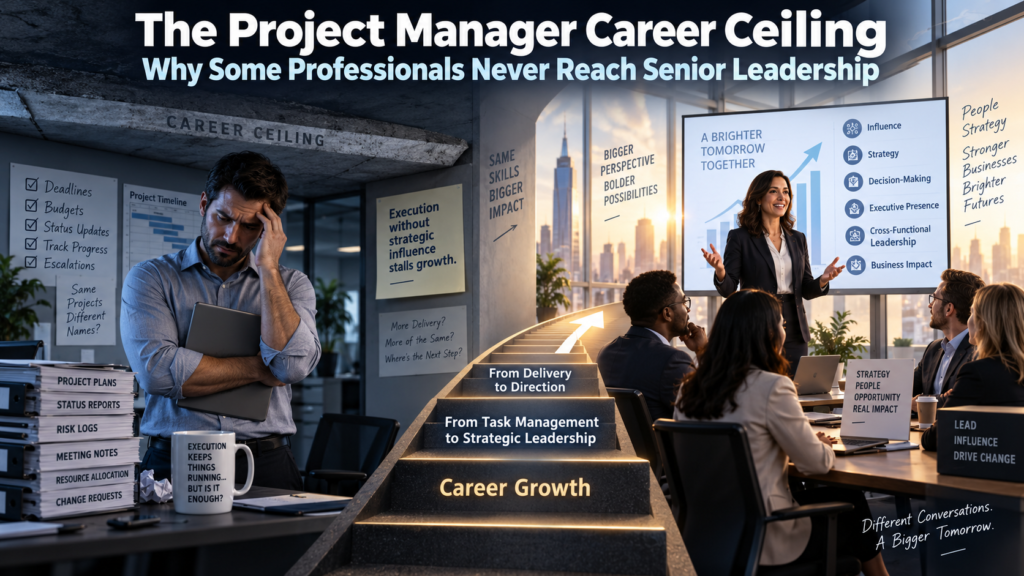
Ten years in, still a Project Manager. Meanwhile, someone who started two years after them is now a Director of Programs. This is the Project Manager career ceiling, and it is one of the most common and least discussed plateaus in corporate careers. It has nothing to do with how well a project was delivered on time and on budget, and everything to do with what happens once delivery becomes routine.
If you’ve felt stuck at the same title for several review cycles despite consistently strong project outcomes, you’re not imagining it. Organisations promote a very specific profile of project manager into senior leadership, and it isn’t always the one with the cleanest delivery record. Below, we break down exactly what causes the Project Manager career ceiling, and the concrete steps including which certifications actually matter to move past it.
What Is the Project Manager Career Ceiling, Really?
The Project Manager career ceiling is the invisible point where technical delivery skill stops translating into further promotion. Below the ceiling, you’re evaluated on whether projects finish on time, on budget, and within scope. Above it, you’re evaluated on whether you can be trusted with strategy, budgets that span multiple projects, and the people who run them.
Most project managers are excellent at the first evaluation and were never taught the second. That gap not a lack of effort or intelligence is what keeps otherwise strong performers stuck at Senior Project Manager or Program Manager for years while less experienced peers move into Director and PMO leadership roles.
Why Some Project Managers Never Reach Senior Leadership
None of the reasons below are about how good someone is at running a project. They’re about what senior leadership actually screens for when filling leadership seats.
1. They optimise for the triangle, not the business case
Scope, schedule, and budget are table stakes. A Project Manager who can only speak to whether the triangle was hit without connecting that outcome to revenue, retention, or strategic priority reads as an operator, not a leader. Executives promote people who can defend a business case, not just a Gantt chart.
2. They manage one project instead of a portfolio
Staying inside a single project, however large, caps the size of decision you’re trusted to make. Portfolio and program-level thinking balancing competing priorities across multiple projects and stakeholders is the single biggest differentiator between a Senior Project Manager and a Program Director.
3. They avoid the politics instead of navigating them
Certified project managers are trained to be neutral facilitators, which sometimes gets misapplied as staying out of organisational politics entirely. Senior leaders don’t avoid politics they read the room, build coalitions, and know which stakeholder relationships matter before a project even starts.
4. They can’t build or develop a team
Running a project team for six months is different from building a department. Project managers who never take on mentoring, hiring, or performance conversations arrive at a leadership interview with no evidence they can lead people, only tasks.
5. They stay certified at entry level
A foundational project management certification proves competence in the fundamentals. Staying there without adding strategic, agile, or portfolio-level credentials signals to a promotion panel that your knowledge stopped growing when the project delivery method didn’t need to.
6. They’re invisible above their own project sponsor
If the only executive who knows your name is your direct project sponsor, you have no advocate in the room when senior roles get discussed. Visibility across the leadership team, not just within your project, is what gets people considered for promotion in the first place.
What Senior Leaders Look For Instead
The project managers who do break through the ceiling consistently show a different pattern before the promotion, not after it:
- They present project outcomes in terms of business value: revenue protected, cost avoided, risk removed.
- They manage or influence a portfolio of projects, not a single delivery stream.
- They build relationships with stakeholders well above their own project sponsor.
- They coach or mentor junior project managers and take ownership of team development.
- They hold certifications that map to strategic and portfolio-level responsibility, not just delivery fundamentals.
Every one of these is learnable. None of them require starting over they build directly on the delivery skills a Project Manager already has.
How to Break Through the Project Manager Career Ceiling
Breaking through isn’t about working longer hours on the same type of project. It’s a deliberate sequence of skill and visibility building most project managers never structure for themselves.
Step 1: Upgrade your certification to match the seat you want
A foundational credential gets you into the profession. Reaching senior leadership usually requires a recognised, higher-level project management certification such as the Project Management Professional (PMP) from the Project Management Institute, or a PRINCE2 Practitioner qualification for governance-heavy environments. Both signal readiness for larger, more strategic responsibility.
Step 2: Learn to speak business case, not just schedule
Practise translating every project update into the language your executives already use: return on investment, cost avoidance, risk exposure, strategic alignment. This single shift changes how senior leaders perceive your judgement, not just your delivery.
Step 3: Add agile and portfolio-level skills
Add agile delivery credentials or portfolio management training on top of your core project management certification. Understanding how to prioritise and sequence multiple competing projects is what qualifies you for program and portfolio-level roles.
Step 4: Take ownership of people, not just tasks
Volunteer to mentor junior project coordinators. Ask for input into hiring or performance conversations on your project team. This is the fastest way to build a leadership track record before you’re officially in a leadership title.
Step 5: Build a stakeholder network above your project sponsor
Present to steering committees. Ask for time with department heads outside your immediate project. Join or start a community of practice for project managers in your organisation. Promotion decisions happen in rooms you need to already be known in.
Step 6: Make your business impact visible, consistently
Keep a running record of the business outcomes your projects have produced cost savings, revenue enabled, risk mitigated and bring it to every performance and promotion conversation. Senior leadership seats go to project managers whose impact is easy to point to, not just easy to feel.
Project Management Certification Demand and Career Growth Across Australia

Demand for project managers who hold a recognised project management certification and can operate at portfolio level remains strong across Australia’s major business hubs. Senior project and program leadership roles in Sydney, Melbourne, Brisbane, Perth, Adelaide, Canberra, and the Gold Coast increasingly list PMP, PRINCE2 Practitioner, or portfolio management experience as a requirement, not just a foundational certificate a clear signal that employers are screening for leadership readiness, not delivery competence alone.
Salary data follows the same trend. Project managers who stop at a foundational certification tend to plateau at the senior individual-contributor level, while those who add PMP, PRINCE2, or agile leadership credentials see the largest jumps into Program Director and PMO Head roles regardless of which Australian city they work in.
Choosing the Right Project Management Certification to Break the Ceiling
Since certification choice materially affects which roles you’re considered for, it’s worth choosing with the next seat in mind, not just the next project. Look for a course or pathway that offers:
- A recognised, globally portable credential PMP, PRINCE2, or an equivalent rather than an unaccredited badge.
- Trainers with genuine program or portfolio-level delivery experience.
- Content that goes beyond exam prep into strategic alignment, stakeholder management, and business case development.
- A clear progression pathway from foundational to practitioner to advanced credentials.
The project management certification courses at Project Management Certifications are built around exactly this progression from Foundation Certificate through to PMP and PRINCE2 Practitioner so candidates are prepared for both the exam and the strategic expectations that come after it.
Frequently Asked Questions
What causes the Project Manager career ceiling?
It’s usually a skills gap, not a performance gap. Project managers hit the ceiling when they’re excellent at delivery but haven’t developed the business-case, portfolio-level, and stakeholder-influence skills senior leadership roles require.
Which project management certification helps the most with promotion?
A foundational certificate proves core competence, but PMP and PRINCE2 Practitioner are the credentials most consistently associated with promotion into senior and program-level roles, particularly when paired with demonstrated portfolio or people-leadership experience.
How long does it typically take to break through the ceiling?
Most project managers who deliberately build strategic, portfolio, and leadership skills alongside an upgraded certification see movement into senior roles within twelve to twenty-four months, compared with staying static for years without a structured plan.
Can a Project Manager move directly into a Program Director role?
Yes. It’s one of the most common promotion paths, particularly for project managers who’ve already taken on portfolio-level responsibility, mentored other project staff, and hold a certification that maps to strategic delivery.
Final Thoughts
The Project Manager career ceiling isn’t a reflection of talent it’s a reflection of which skills you’ve had the opportunity, or the deliberate plan, to build. The professionals who break through don’t necessarily deliver better projects than their peers. They simply stopped optimising for the delivery triangle alone and started building the business, portfolio, and leadership skills senior roles actually screen for.
If you’re ready to start building those skills the right way, explore the project management certification courses and take the first step toward the senior leadership seat that’s currently just out of reach.