



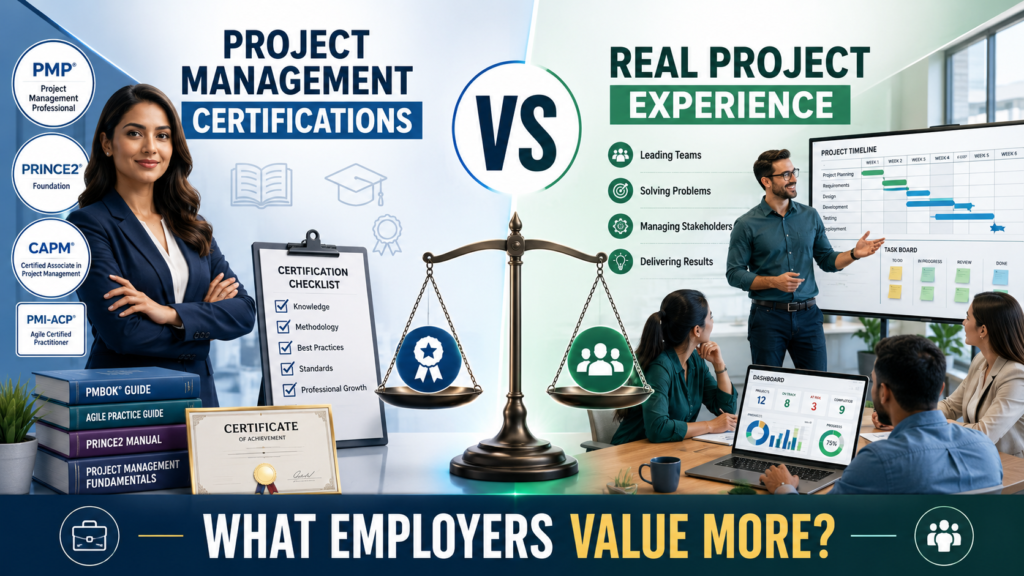
It’s one of the most common questions in project management career forums: should you spend your time and money chasing project management certifications, or focus on building real project experience instead? The honest answer is that Australian employers rarely see it as an either/or choice they’re looking for evidence of both, and candidates who only have one side of that equation tend to stall at mid-level roles.
This article breaks down the project management certifications vs real project experience debate in plain terms, and shows exactly how to build a profile that covers both, whether you’re based in Melbourne, Sydney, Brisbane, Perth, Adelaide or Canberra.
What Certifications Actually Prove to Employers
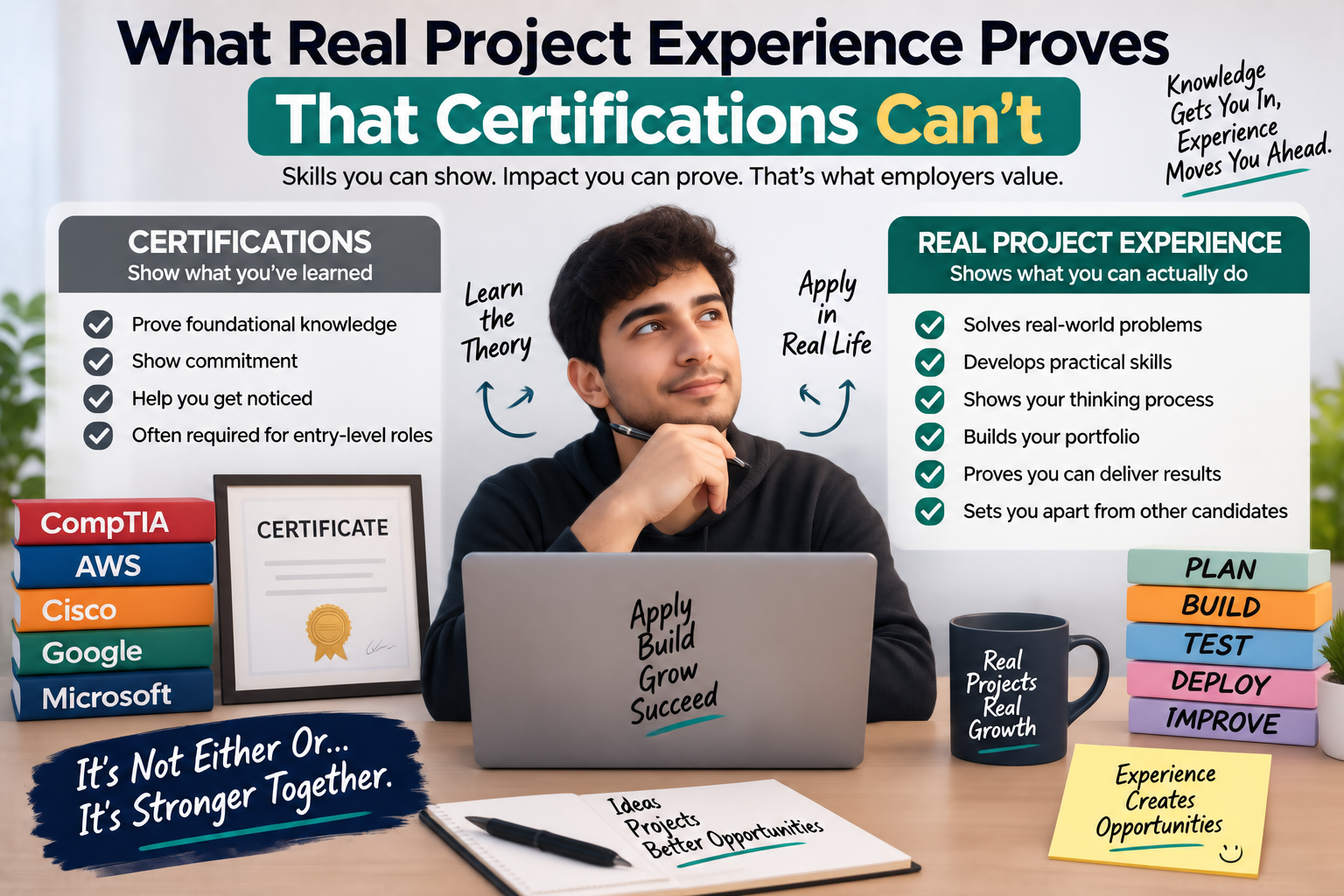
A recognised certification such as PRINCE2 Foundation, PRINCE2 Practitioner, or the Project Management Professional (PMP) credential tells a hiring manager that you understand recognised frameworks, terminology and governance without needing to test that knowledge from scratch in an interview.
- They provide a shared vocabulary and framework recruiters can screen for quickly.
- They demonstrate structured knowledge of planning, budgeting, risk and governance.
- Many government and enterprise tenders require certified project managers on staff.
- They help career changers enter project management without years of prior title experience.
What a certification alone can’t prove is how you actually behave when a project timeline slips, a stakeholder pushes back, or a budget gets cut halfway through delivery.
What Real Project Experience Proves That Certifications Can’t
Real project experience is what shows an employer you can apply a framework under pressure, not just describe it. Delivering an actual project even a smaller one forces you to navigate the parts no textbook fully prepares you for: shifting scope, difficult stakeholders, resourcing gaps and unexpected risks.
What hiring managers are really testing for
- Can you re-plan a project when a major risk materialises mid-delivery?
- Can you manage a stakeholder who disagrees with your timeline or budget?
- Can you report project status clearly to executives under pressure?
- Have you actually closed out a project, not just started one?
This is exactly why practical, scenario-based learning has become such a core part of modern project management training theory explains the framework, but applied practice is what builds the judgement to run it.
So Which Do Employers Value More?
In practice, certifications open the door and real project experience decides who walks through it. A PRINCE2 or PMP credential gets your resume shortlisted and signals credibility to recruiters and hiring panels. But when two candidates hold the same certification, the one with a track record of delivering real projects on time, on budget, through genuine setbacks is the one who gets the offer.
This mirrors what’s happening industry-wide across construction, IT, healthcare, finance and government sectors: certified project managers who can also demonstrate hands-on delivery experience are consistently the most competitive candidates, which is exactly the combination covered by structured Project Management Certifications training that pairs certification content with real-world application.
The Employer’s Checklist in 2027
- A recognised certification such as PRINCE2, AgilePM, CompTIA Project+ or PMP.
- Evidence of real projects delivered even small ones, with measurable outcomes.
- The ability to explain a difficult project decision, not just recite a framework.
- Stakeholder communication and leadership skills, demonstrated with examples.
- Familiarity with both traditional and Agile delivery approaches.
How Structured Training Closes the Gap
This is the exact gap that Project Management Certifications training is designed to close. Rather than choosing between exam preparation and practical skills, the courses combine certification-aligned content covering project planning, scheduling, budgeting, risk management, stakeholder engagement and governance with hands-on learning that mirrors real workplace project delivery.
Popular pathways include PRINCE2 Foundation, PRINCE2 Agile Foundation, AgilePM Foundation, AgilePM Practitioner, BCS IS Project Management Foundation, CompTIA Project+, and the advanced PMP Certification pathway for experienced professionals. You can view the full certifications list to compare which pathway fits your experience level.
Available Across Every Major Australian City
Training is delivered through flexible online and instructor-led formats for professionals in Melbourne, Sydney, Brisbane, Perth, Adelaide, Canberra, as well as Hobart and Darwin. See the full locations page for details in your city.
What the Data Says About Project Management Demand
Independent workforce research supports why both sides of this equation matter. Demand analysis from bodies such as the Project Management Institute and workforce data from the Australian Bureau of Statistics consistently show project management skills shortages across construction, IT and government sectors meaning certified, experienced project managers can be selective about which roles they take, rather than the other way around.
6 Steps to Build a Profile That Covers Both Sides
- Choose a certification pathway that matches your experience level Foundation, Practitioner or PMP.
- Enrol in training that includes real-world scenarios and case studies, not slides alone.
- Volunteer to lead or co-lead a project at work, even a small one, to build a track record.
- Document outcomes: budget managed, timeline met, risks mitigated, stakeholders aligned.
- Practise explaining a difficult project decision out loud before interviews.
- Target your certification and experience toward the city and industry with strongest demand.
Frequently Asked Questions
Do I need a certification to become a project manager in Australia?
Not always, but it significantly improves your chances of being shortlisted, especially for your first project management role or when moving from a coordinator position into full ownership of projects.
Is real project experience more important than certification?
For progressing into senior and PMP-level roles, yes certifications open the door, but employers promote based on a demonstrated track record of successful project delivery.
What’s the fastest way to build both certification knowledge and real experience?
Structured training that combines certification preparation such as PRINCE2, AgilePM or PMP with hands-on, scenario-based learning is the most efficient way to build both at the same time.
Start Building a Job-Ready Project Management Profile
The project management certifications vs real project experience debate isn’t really either/or employers want proof of both. If you’re ready to build a profile that covers the certification employers screen for and the practical delivery experience they actually hire on, explore the full range of Project Management Certifications, browse courses by level, read the blog, check the FAQs, or contact the team to find the right training pathway in your city.