


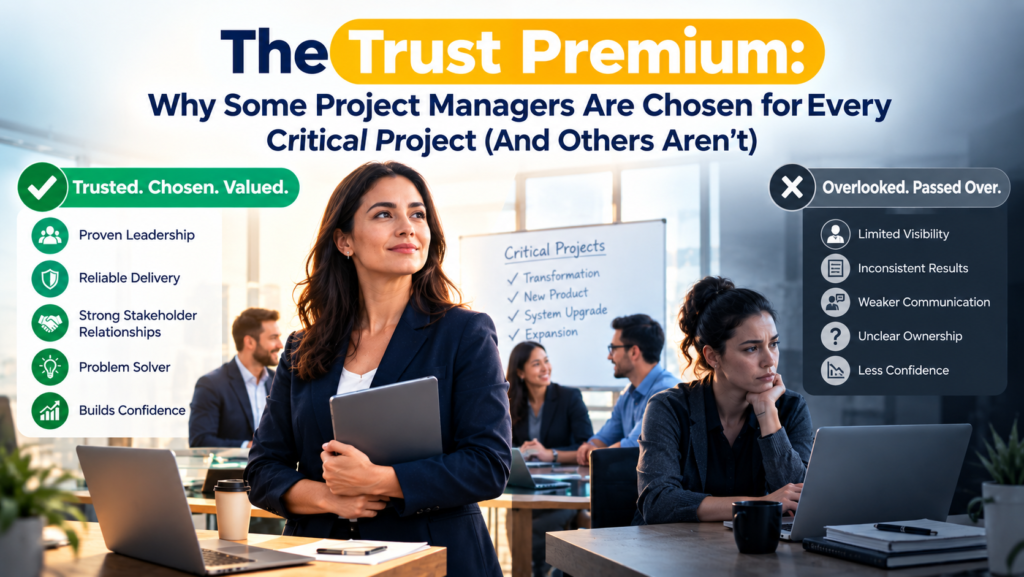

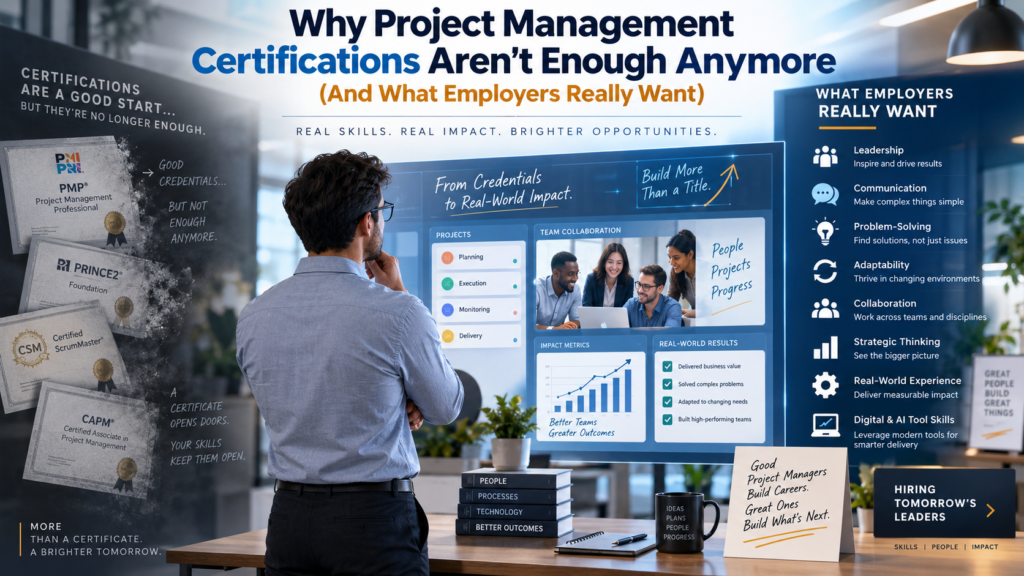
A decade ago, adding a certification to your resume was often enough to get shortlisted for a project coordinator or project manager role. That’s changed. Today, project management certifications are still a strong signal of foundational knowledge, but hiring managers across Melbourne, Sydney, Brisbane, and beyond are asking a harder question in every interview: can you actually deliver a project, on budget, with a difficult stakeholder pushing back the whole way?
This shift doesn’t mean certifications have lost their value. It means they’ve become the entry ticket rather than the whole show. If you’re weighing up PRINCE2, PMP, AgilePM, or CompTIA Project+, this guide breaks down exactly why certification alone isn’t cutting it in 2026, and what you can pair it with to stand out.
The Real Demand for Project Managers Hasn’t Gone Away
If anything, the market for skilled project professionals is tightening. PMI’s Global Project Management Talent Gap report found that the world could need up to 30 million additional project professionals by 2035, with almost 40 million already working in the field globally.
That kind of demand is good news for anyone pursuing project management certifications. But it also means employers can afford to be selective, and selective hiring managers are screening for more than a certificate number on a CV.
Why Project Management Certifications Alone Don’t Get You Hired
Certifications like PRINCE2 or PMP prove you understand a framework: how to structure a project charter, run a risk register, or manage a stage gate. What they can’t prove on their own is judgement. Employers have learned, often the hard way, that a certified project manager and a project manager who can actually navigate ambiguity are not always the same person.
- Certifications test knowledge recall, not decision-making under pressure.
- They rarely demonstrate stakeholder management or conflict resolution in practice.
- They don’t show whether you can adapt a methodology to a messy, real-world project.
- They say nothing about your communication style, which is often the deciding factor in interviews.
What Employers Really Want From Project Managers in 2026
Speak to recruiters and hiring managers across Australia and a consistent pattern emerges. They want the theory that project management certifications provide, combined with evidence of applied delivery skills. Here’s what tends to move candidates to the top of the shortlist.
1. Proof of Delivered Outcomes, Not Just Process Knowledge
Employers want to hear about a specific project you delivered: the budget, the timeline, the obstacle, and how you solved it. A certification shows you know what a RAID log is; a strong interview answer shows you’ve actually used one to keep a project on track.
2. Stakeholder and Communication Skills
Most project failures trace back to poor communication, not poor scheduling. Employers increasingly test for this directly, asking how you’ve handled a stakeholder who disagreed with your plan or a sponsor who kept changing scope.
3. Comfort With Agile, Hybrid, and Traditional Approaches
Few organisations run pure Waterfall or pure Agile anymore. Hiring managers want project managers who can flex between PRINCE2-style governance and Agile sprints depending on the project, which is why pairing a foundational certification with an Agile-focused one, such as AgilePM Foundation, is increasingly common.
4. Digital and Data Literacy
Reporting, dashboards, and resource forecasting increasingly happen inside collaborative tools rather than static spreadsheets. Basic comfort with data-driven reporting tools is now expected, particularly for roles touching IT or construction delivery.
5. Commercial and Risk Awareness
Employers want project managers who understand budgets and risk exposure the way a business owner would, not just the way a textbook describes them. This is where certifications like CompTIA Project+ or PRINCE2 Practitioner-level training help, because they go beyond terminology into applied budgeting and risk frameworks.
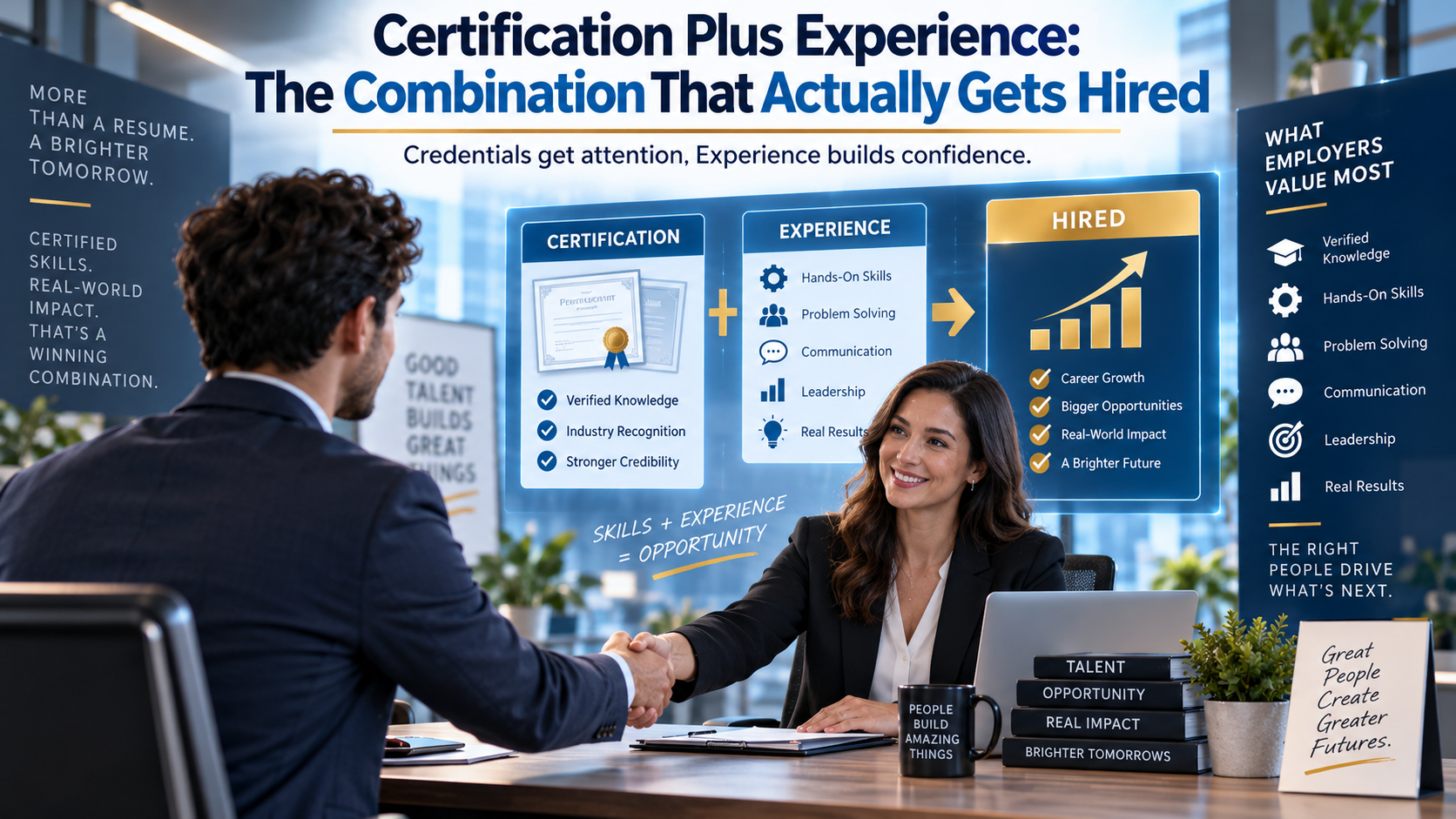
Certification Plus Experience: The Combination That Actually Gets Hired
The strongest candidates aren’t choosing between certification and experience, they’re stacking both. A typical competitive profile now looks like: a recognised certification, a portfolio of real project outcomes (even small ones), and demonstrable soft skills backed by examples.
If you’re mapping out which certification to add next, it’s worth matching the credential to the gap in your CV rather than chasing the most popular acronym. Our most requested pathways include:
- PRINCE2 Foundation for structured, governance-heavy environments such as government and construction
- PRINCE2 Agile Foundation and AgilePM Foundation for hybrid delivery teams
- CompTIA Project+ for IT-adjacent project coordinators building their first credential
- Project Management Professional (PMP) for experienced managers targeting senior delivery roles
- Project Planning & Control for professionals who want deeper scheduling and cost-control expertise
Project Management Certifications Across Australia
Because employer expectations shift slightly by industry and region, it helps to train close to the market you’re targeting. We deliver project management certifications and instructor-led training across major Australian cities, including:
- Melbourne, where construction, finance, and healthcare employers are driving strong demand
- Sydney, with IT, professional services, and government project roles leading hiring
- Brisbane, where infrastructure and engineering projects are expanding rapidly
- Perth, supporting resources, mining, and energy sector project delivery
- Canberra, with strong government and public-sector demand for certified project managers
- Adelaide, where defence and manufacturing projects continue to grow
You can view the full course catalogue on our Project Management Certifications page, or check current schedules on the Locations page for your city.
How to Future-Proof Your Project Management Career
- Pick a certification that matches the industry you actually want to work in, not just the most talked-about one.
- Document real project outcomes as you go, even informal ones, so you have concrete examples ready for interviews.
- Practise explaining how you handled a difficult stakeholder or a scope change; this comes up in almost every senior interview.
- Layer a second, complementary certification (for example PRINCE2 plus AgilePM) once you’ve applied the first one on the job.
- Keep your CV outcome-focused: budgets managed, timelines hit, teams led, rather than a list of responsibilities.
Frequently Asked Questions
Are project management certifications still worth it in 2026?
Yes. Certifications remain one of the fastest ways to prove foundational knowledge to employers and recruiters, and they’re often a filtering requirement in job ads. They just work best when paired with demonstrable delivery experience.
Which project management certification do employers prefer, PMP or PRINCE2?
Neither is universally ‘better’ — PMP is widely recognised internationally and suits senior, cross-industry roles, while PRINCE2 is especially valued in Australian government, construction, and corporate environments. Many professionals hold both.
Can I get a project management job with only a certification and no experience?
It’s possible for coordinator-level or junior roles, particularly if you can point to relevant transferable experience, but most mid-to-senior roles expect certification plus evidence of applied project delivery.
Ready to Close the Gap Between Certification and Career?
If you’re ready to move beyond theory and build the project management certifications and applied skills employers are actively hiring for, explore our full course range or speak with our team about the right pathway for your industry and city.
View Project Management Certifications | Contact Us | Call 1300 649 299