
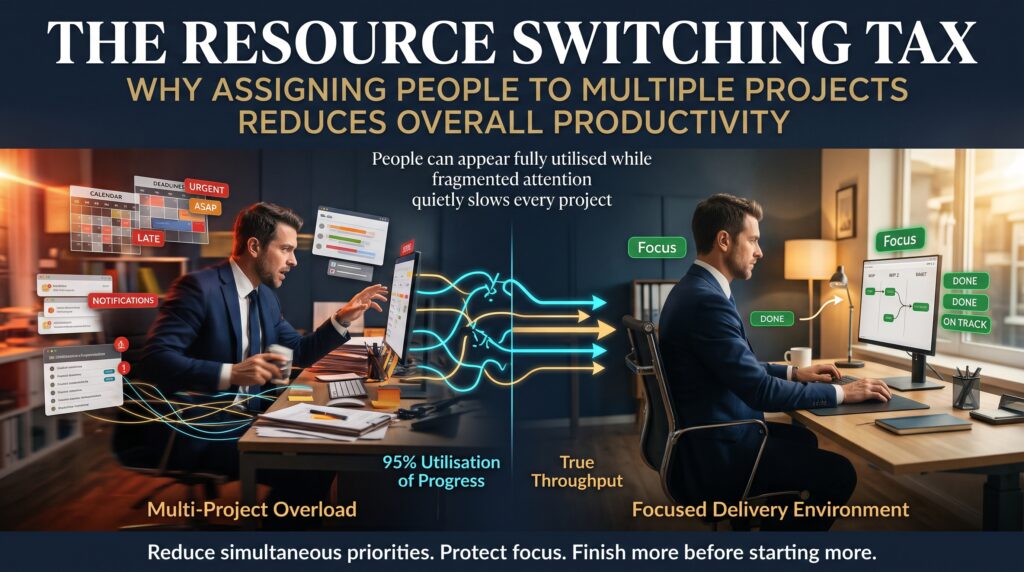

Context switching is the mental and practical cost of moving a person’s attention from one project to another, and it is the hidden tax every organisation pays when it splits people across multiple projects. On a resource plan, four projects at 25 percent each looks like a perfectly full week. In real life, it often produces four late projects and one exhausted employee.
This is the resource switching tax, and context switching is its engine. It never appears as a line item, yet it quietly reduces output, stretches delivery dates and lowers quality. If your team always seems busy but projects keep slipping, this guide explains why, how to measure the damage and what project managers can do about it.
| Quick answer
Assigning one person to several projects reduces overall productivity because context switching costs time to recover focus, re-read context, attend extra meetings and rebuild momentum. Reduce the tax by limiting how many projects each person works on, sequencing work, allocating larger blocks of time and planning for less than full utilisation. |
What Is Context Switching and Why Does It Cost So Much?
Context switching happens when someone stops one piece of work and starts another that needs different information, people, tools and decisions. It sounds small. A quick message here, a short meeting there. But each switch asks the brain to unload one set of details and load another.
Psychologists have studied this for decades. The American Psychological Association explains that mental “blocking” during task switching can cost time and reduce accuracy, especially on complex tasks, in its overview of multitasking and switching costs. Researchers also describe attention residue, where part of your mind stays with the previous task even after you move on. A broader summary of the topic appears under human multitasking.
In project work, the cost is bigger than the mental pause. People also need to switch tools, folders, meetings, stakeholders and vocabulary. A business analyst moving from a finance project to a logistics project is not just changing tasks. They are changing worlds.
The Context Switching Story: Busy on Paper, Late in Practice
Picture a Perth engineering firm with a strong senior analyst. Four project managers each ask for a quarter of her time, and the resource plan shows her at a tidy 100 percent.
In reality, her mornings go to remembering where each project stands. She attends four sets of status meetings, answers four sets of questions and rarely gets two clear hours in a row. Each project waits on her input for days. All four finish late, and nobody can point to a single mistake. (This scenario is an illustration, not a real case.)
When the firm later cuts her context switching by reducing her to two projects and sequencing the rest, both remaining projects speed up, and the delayed ones start sooner than they would have.
The Resource Switching Tax: How Multiple Projects Reduce Productivity
A well-known rule of thumb, often credited to software management author Gerald Weinberg, shows how quickly the tax grows. It is a heuristic rather than a precise law, but it makes the point clearly.
| Projects per person | Time per project | Time lost to switching |
| 1 | 100% | 0% |
| 2 | 40% each | 20% |
| 3 | 20% each | 40% |
| 4 | 10% each | 60% |
| 5 | 5% each | 75% |
The numbers are illustrative, and real losses vary by work type, but the pattern holds: each additional project takes a larger bite than the one before. The loss is not only the switching itself. It also includes lower quality of thought, more mistakes and longer queues of work waiting for the same person.
Why Organisations Keep Splitting People Across Projects
Understanding why leaders accept constant context switching is the first step to changing it.
- Utilisation obsession. Leaders want everyone “fully used”, so any gap in a calendar gets filled.
- Spreadsheet thinking. Percentages add up neatly to 100, even though attention does not divide that way.
- Scarce specialists. Every project wants the same few experts, so they get sliced thin.
- Over-committed portfolios. Too many projects start at once because saying no feels harder than saying yes.
- Invisible costs. Context switching time is not tracked, so nobody can prove it exists.
- Everyone wants a little. Each manager asks for “just a few hours”, and the total quietly becomes unmanageable.
The Hidden Costs of Context Switching Beyond Lost Hours
Context switching costs far more than the minutes it takes to change windows.
Queues and delays that compound from context switching
When a person is shared, work waits until they are free. According to Little’s law, more work in progress means longer lead times for every item. A shared expert at high utilisation becomes a queue that slows every project they touch.
Lower quality and more rework from context switching
Tired, fragmented attention leads to missed details and weaker decisions. The cost of fixing mistakes later usually exceeds the time that appeared to be saved by squeezing in one more project.
Weak handovers and lost knowledge
Part-time team members carry less context and attend fewer discussions. Information gets lost, and decisions are repeated.
Burnout and disengagement
People who feel permanently behind on several fronts lose motivation. Good performers, especially, may leave.
Bottlenecks hidden inside the plan
A shared resource often sits on several critical paths at once, which means one delay ripples across the portfolio. The idea is explored in critical chain project management, which treats harmful multitasking as a major cause of delay.
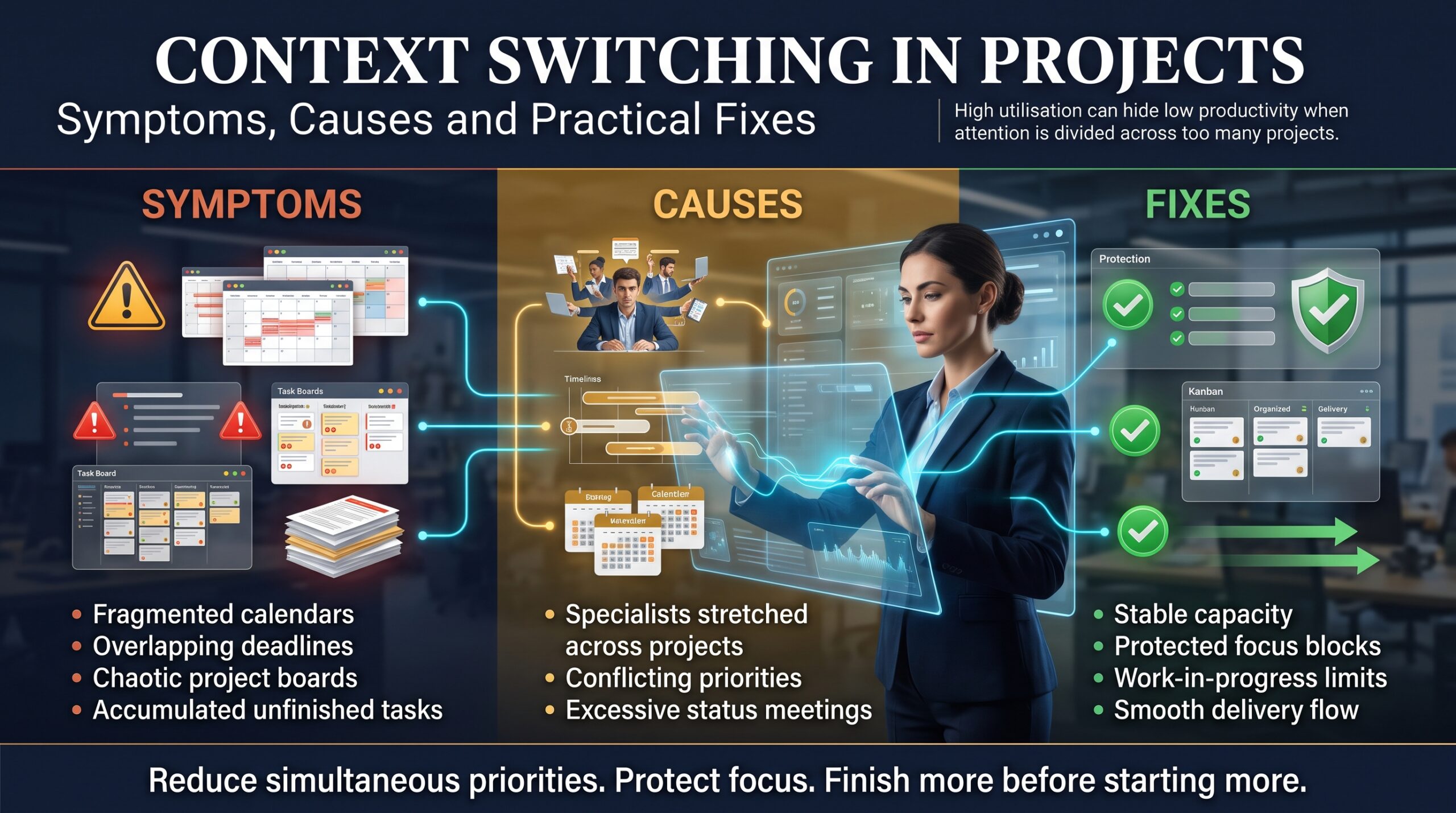
Cheat Sheet: Symptoms, Causes and Fixes for Context Switching in Projects
Use this table to match what you see with the likely cause of context switching in your team.
| What you notice | Likely cause | Quick fix |
| Everyone is busy, yet projects are late | Too many projects per person | Limit active projects per person and sequence the rest |
| Key experts always respond slowly | Shared specialist is a bottleneck | Create an intake queue and protect focus time |
| Status meetings multiply | Same person attends several projects | Combine meetings and use short written updates |
| Quality dips as workload rises | Fragmented attention | Allocate larger blocks of time to fewer tasks |
| New projects start while old ones drag | No portfolio prioritisation | Cap work in progress and finish before starting |
How to Measure the Resource Switching Tax: A Seven-Step Routine
You do not need new software. A spreadsheet and some honest conversations will reveal your context switching.
- List every person and every project they support. Count how many active projects each individual touches in a typical week.
- Flag people on three or more projects. These are the most likely sources of hidden delay.
- Measure focus blocks. Ask how many uninterrupted blocks of two hours or more each person gets in a week.
- Count meetings per person. Note how many status, planning and review meetings they attend across projects.
- Compare planned and actual effort. Look for tasks that regularly take much longer than estimated when assigned to shared people.
- Track waiting time. Measure how long work waits for input from shared resources before anyone works on it.
- Ask the people involved. A short, anonymous survey on how often they switch and how it affects their work is revealing.
How to Reduce Context Switching Across Multiple Projects
- Limit work in progress per person. Aim for one main project, with at most one other. Fewer is usually faster.
- Prioritise at portfolio level. Decide which projects matter most and delay the rest instead of starting everything.
- Sequence instead of splitting. Two projects done one after the other often finish sooner than the same two done in parallel.
- Use dedicated core teams. Stable teams who work together on one initiative build shared context and momentum.
- Allocate time in larger chunks. Give a person full days or half-weeks on a project, not scattered hours.
- Protect focus time. Block uninterrupted periods and batch meetings together.
- Plan for less than full utilisation. Leave capacity for urgent work and unplanned issues, so a small shock does not derail everything.
- Manage specialists through a queue. A visible intake list with clear priorities beats ad hoc requests.
- Make the tax visible. Report the number of projects per person alongside utilisation, so leaders can see the trade-off.
Many organisations use resource leveling to balance demand and capacity, but leveling only works when the underlying assumption, that hours are interchangeable, is challenged. The Project Management Institute publishes wider guidance on resource management and portfolio practice.
The Project Manager’s and PMO’s Role
Project managers cannot fix this alone, because allocation decisions are often made above them. But they can gather evidence about context switching, show the trade-offs and suggest clearer rules.
A project management office can go further. It can maintain a single view of demand across the portfolio, set limits on concurrent projects to cap context switching, guide prioritisation and report on delivery speed rather than only utilisation.
Context Switching Metrics Worth Tracking
- Average number of active projects per person.
- Planned versus actual time on shared tasks.
- Lead time from request to completion for key deliverables.
- Waiting time for specialist input.
- Focus-block count per person per week.
- Employee pulse feedback on workload and interruptions.
Project Management Courses That Build Planning and Resource Skills
Reducing context switching draws on planning, prioritisation, stakeholder influence and governance. These programs at Project Management Certifications match those skills.
- PRINCE2 Project Management Foundation and PRINCE2 Project Management Practitioner cover governance, planning and control.
- PRINCE2 Agile Foundation and PRINCE2 Agile Practitioner blend structured governance with agile ways of working.
- AgilePM Foundation and AgilePM Practitioner focus on agile project delivery, including timeboxing and focused teams.
- BCS IS Project Management Foundation introduces project management for information systems.
- CompTIA Project+ Certification (PK0-005) suits people managing smaller IT and business projects.
- Project Planning & Control builds scheduling and control skills for complex work.
- Project Management Professional (PMP) Certification is an advanced credential for experienced project leaders.
Browse everything on the certifications page, or explore the foundational, intermediate and advanced categories. You can also check the FAQs, learn more about us or read the Project Management Certifications blog.
Project Management Training Across Australian Cities
Project teams in every city face the same context switching problem, and skilled project managers are in demand nationwide.
- Melbourne: construction, technology, health and government projects. See project management certifications in Melbourne.
- Sydney: finance, infrastructure and professional services portfolios. See project management certifications in Sydney.
- Brisbane: infrastructure, resources and public sector programs. See project management certifications in Brisbane.
- Perth: mining, energy and engineering projects. See project management certifications in Perth.
- Adelaide: defence, health and education projects. See project management certifications in Adelaide.
- Canberra: government programs with complex governance. See project management certifications in Canberra.
Training is offered live online across Australia, with in-house options for teams. View all locations or contact the team to plan training for your project group.
Frequently Asked Questions About Context Switching in Projects
What is the resource switching tax?
The resource switching tax is the hidden productivity loss from context switching when people are assigned to several projects at once.
What is context switching in project management?
Context switching is the loss of focus and time that occurs when a person moves between different projects or tasks that need different information, people and tools.
Does multitasking reduce productivity in project teams?
Generally, yes. Switching between demanding tasks adds recovery time, increases errors and lengthens queues, so total output often falls even though everyone looks busy.
How many projects should one person work on?
There is no universal number, but fewer is usually better. Many teams aim for one main project with, at most, a second smaller one.
What is the cost of context switching?
Costs include lost time, reduced quality, more meetings, delayed projects and lower morale. A commonly cited rule of thumb suggests the loss rises sharply with each extra project, though real figures vary.
How do you reduce multitasking in a project portfolio?
Limit work in progress per person, prioritise at portfolio level, sequence projects, protect focus time and plan resource capacity below 100 percent.
Is 100 percent resource utilisation a good goal?
Not usually. Running people at full capacity leaves no room for urgent issues and causes queues to grow. Planning some slack typically improves delivery speed.
Which project management course should I start with?
Many people begin with PRINCE2 Foundation, AgilePM Foundation or CompTIA Project+, then move to practitioner or PMP level.
Final Thoughts: Stop Paying the Switching Tax
The resource switching tax, driven by context switching, is not a sign of weak people. It is the predictable result of spreading talented people too thinly. Percentages on a plan feel precise, but attention does not divide neatly.
Count how many projects each person carries, protect focus, finish before starting and teach leaders to see the cost of constant context switching. Do that, and projects speed up without anyone working harder. If you want structured, practical project management training, speak with an advisor at Project Management Certifications on 1300 649 299, or explore the full certification list to find your starting point.