


The decision queue problem is the quiet reason so many projects finish late even when everyone on the team is working flat out. Nobody puts it on the risk register. It never gets its own line in the status report. Yet if you track a single task from start to finish, you will often find it spent more days sitting in someone’s inbox than it ever spent being worked on.
If that sounds familiar, you are not imagining it, and you are not alone. Project managers in Sydney, Melbourne, Brisbane and every other Australian city describe the same pattern: the team is ready, the work is clear, and then everything stops while a decision makes its way through a chain of busy people. This guide explains why the decision queue problem happens, how to spot it early, and what you can do about it starting this week.
What Is the Decision Queue Problem?
Think of every approval, sign-off, budget release, design review and change request as a customer waiting in a line. Each one needs a decision from a person with limited time. When decisions arrive faster than decision-makers can clear them, a queue forms. Work that depends on those decisions stalls, and the team either sits idle or starts something new that they will have to rework later.
That is the decision queue problem in plain language: the time a piece of work spends waiting for a decision is longer than the time spent doing the work itself. The delay is not caused by laziness or poor skills. It is a flow problem, the same kind of problem you see in traffic jams and hospital waiting rooms.
The chart above shows an illustrative task. The team needs four days of real effort, but the task takes ten calendar days to finish because it waits twice. Multiply that across dozens of tasks and the schedule slips by weeks, even though the team never worked slowly.
Why Approval Delays Cost More Than Most Project Teams Realise
Waiting looks harmless on a Gantt chart because nobody is spending money while a document sits in review. In reality, delays are expensive in at least four ways.
- Idle or distracted people. Team members who cannot proceed either wait or switch to other work, and switching back later costs focus and time.
- Teams often keep building on assumptions while they wait. If the final decision goes the other way, that work is thrown away.
- Missed windows. Suppliers, contractors and venues do not wait for your internal sign-off. A late decision can mean a lost booking or a higher price.
- Stakeholder frustration. Sponsors see a late project and assume the delivery team is at fault, even when the delay started on their own desks.
Research backs this up. A survey of more than 150 construction professionals, published in the International Journal of Information Technology Project Management, identified approval delays and slow decision-making among the key contributors to project delays. A study of hotel construction projects from the University of Moratuwa went further and uncovered 20 separate causes of delay inside the pre-construction approval process alone. The pattern is consistent: the decision queue problem is common, measurable and fixable.
Warning Signs of the Decision Queue Problem in Your Team
You do not need special software to detect a decision queue. Watch for these signals in your next stand-up or status meeting:
- The same item appears under “blocked” for more than one reporting period.
- Team members say “I’m waiting on…” more often than “I’m working on…”
- Approvals are chased by email, chat and corridor conversations all at once.
- Decisions are made, then reopened by a new reviewer who joined late.
- Work is started “at risk” because nobody believes the approval will arrive on time.
- Sponsors and executives say they are too busy to review, yet the project is on their priority list.
If you recognise three or more, you have a decision queue problem, and it is worth treating it as a project risk in its own right.
The Real Causes Behind Slow Project Approvals
Too many approval layers
Every extra signature adds waiting time and very little extra safety. Many organisations add layers after one bad experience and never remove them. The result is a process built for the rare disaster that slows down every ordinary task.
Unclear decision rights
When nobody knows who actually owns a decision, everyone waits for someone else. Is it the sponsor, the steering committee, the portfolio office or the business owner? Without a clear answer, requests bounce around until someone finally takes responsibility.
Overloaded decision-makers
Senior people sit on many projects at once. Your request is one of dozens, and it is usually not the most urgent thing in their week. A queue forms simply because the capacity to decide is smaller than the demand for decisions.
Poorly prepared requests
A request that arrives without context, options or a recommendation forces the approver to do extra thinking, so it gets postponed. Vague requests wait longer than sharp ones.
Fear of being wrong
In some cultures, signing off feels risky and delaying feels safe. People ask for one more review, one more opinion, one more report. Caution is reasonable, but endless caution is just a slower way to fail.
How to Fix the Decision Queue Problem: 7 Practical Steps
The good news is that you do not need a big transformation programme. Most project teams can shrink their decision queue with a handful of small, deliberate changes.
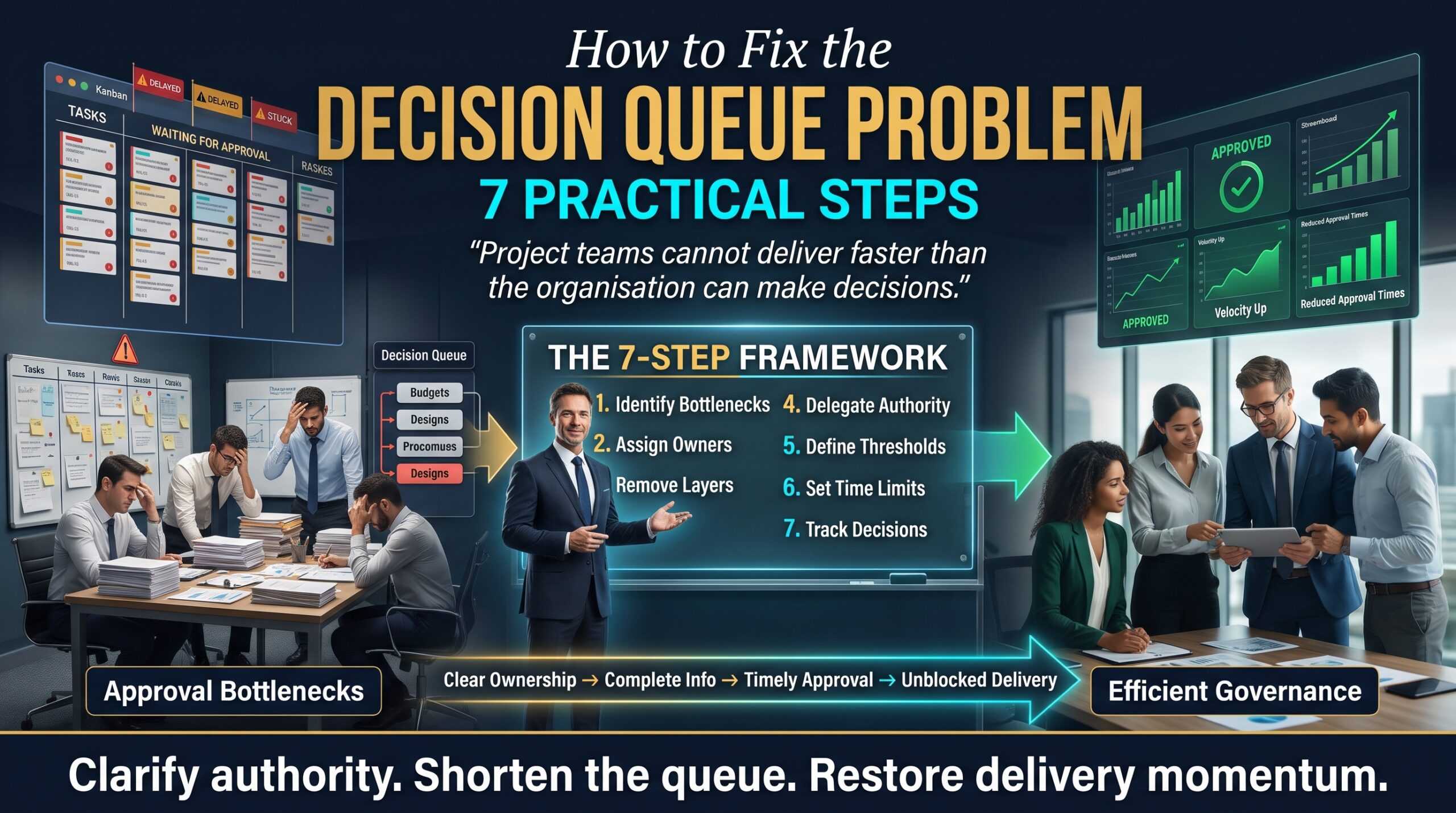
1. Map and measure the waiting time
For two weeks, record when each request is sent and when the decision comes back. Separate “work time” from “wait time”. Once the data is visible, conversations with sponsors change from opinions to evidence.
2. Name one decision owner for every decision type
Create a simple decision-rights table: what is being decided, who decides, who must be consulted and who only needs to be informed. Publish it in the project charter so nobody has to guess.
3. Set service-level targets for approvals
Agree on a target response time, for example two working days for routine requests and five for major ones. Treat the target the way you would treat any other commitment in the plan. If a decision runs past the limit, it escalates automatically.
4. Cut approval layers and use delegated authority
Ask for every layer: what risk does this signature protect us from? Where the honest answer is “none”, remove it. Give team leads authority to approve below a clear cost or scope threshold so that only genuinely big decisions travel upwards.
5. Prepare decision-ready requests
Write requests so the approver can say yes in under a minute: a one-line summary, the decision needed, two or three options, your recommendation and the cost of waiting. Decision-makers approve quickly when thinking has already been done for them.
6. Book decision slots in advance
Rather than sending requests randomly, hold a standing 30-minute decision meeting each week with the sponsor or steering group. Batch the requests and clear them together. This also gives executives a predictable rhythm instead of constant interruptions.
7. Log the delay as a risk and track it
Practitioners on the Project Management Institute community have long recommended logging approval delay as an explicit risk and using automated approval tools where possible. A named risk gets an owner, a mitigation plan and a place on the agenda, which is exactly what a decision queue problem needs.
Decision Queue Problem Examples Across Australian Industries
The decision queue problem shows up everywhere, but it looks slightly different in each sector.
- Construction and infrastructure: design sign-offs, council approvals and variation orders pile up while crews and equipment wait on site.
- IT and digital delivery: architecture reviews, security approvals and change-board meetings hold back release dates. Agile teams feel this sharply, because sprint goals depend on quick answers.
- Government and public sector: layered governance and procurement rules slow even simple decisions, particularly in Canberra where multiple agencies often share ownership.
- Healthcare and finance: compliance and clinical or risk reviews create necessary but sometimes poorly scheduled queues.
Whichever sector you work in, the decision queue problem follows the same logic. Whether you manage a build in Perth, a digital rollout in Melbourne, or a government program in Canberra, the fixes above apply. Only the names of the committees change.
Project Management Skills That Help You Break the Queue
Tools and templates only go so far against the decision queue problem. Lasting improvement comes from project managers who understand governance, stakeholder engagement and risk, and who know how to negotiate decision rights before a project starts. This is the practical territory covered by recognised certifications.
- PRINCE2 Project Management Foundation teaches clear roles, stage gates and management by exception, which is essentially a structured answer to the decision queue problem.
- PRINCE2 Project Management Practitioner builds the skills to apply those governance themes on real projects.
- AgilePM Foundation and AgilePM Practitioner focus on empowered teams and fast, delegated decisions.
- PRINCE2 Agile Foundation combines governance with agile delivery, which suits teams caught between rigid approval processes and fast sprints.
- Project Management Professional (PMP) Certification covers stakeholder, schedule and risk management at a senior level.
- CompTIA Project+ (PK0-005) is a practical option for IT professionals who manage projects without the formal title.
- Project Planning & Control helps you build schedules that show waiting time honestly instead of hiding it.
You can browse the full list on the project management certifications page or compare course formats on our project management courses page.
Project Management Training in Sydney, Melbourne, Brisbane and Beyond
You do not need to travel to build these skills. Flexible online and instructor-led options are available for professionals in Sydney, Melbourne, Brisbane, Perth, Canberra and Adelaide, as well as Hobart and Darwin through live online delivery. Prefer a team solution? Ask about in-house group training and bring the whole project group into the same room, which is one of the fastest ways to agree on decision rights together.
Not sure which course fits? Read our FAQs, check the project management blog for more guides, or contact our team or call 1300 649 299 for a no-pressure chat.
Frequently Asked Questions About the Decision Queue Problem
What is the decision queue problem in project management?
The decision queue problem is the situation where work waits longer for approvals and decisions than it takes to actually do the work. It is a flow and governance issue, not a performance issue with the team.
How do you reduce approval delays on a project?
To tackle the decision queue problem, name a single decision owner, set response-time targets, remove unnecessary approval layers, use delegated authority and send decision-ready requests. Measuring wait time first makes the case for change much easier.
Does agile solve the decision queue problem?
Agile helps by empowering teams to decide within agreed boundaries, but it does not fix the problem on its own. Agile teams still stall if sponsors and governance boards are slow to respond.
Which project management course teaches governance and decision-making?
PRINCE2 is built around governance, roles and stage-based decisions, and PMP covers stakeholder and risk management in depth. AgilePM is a strong choice for teams that need fast, delegated decisions.
Final Thoughts: Stop Waiting and Start Delivering
The decision queue problem is not a mystery and it is not a character flaw in your organisation. It is a predictable result of busy people, unclear ownership and too many layers. Measure it, name it, and design it out of your process, and you will give your team back the days they currently lose to waiting.
If you want the skills to lead that change with confidence, explore our project management certifications and take the next step in your career.