
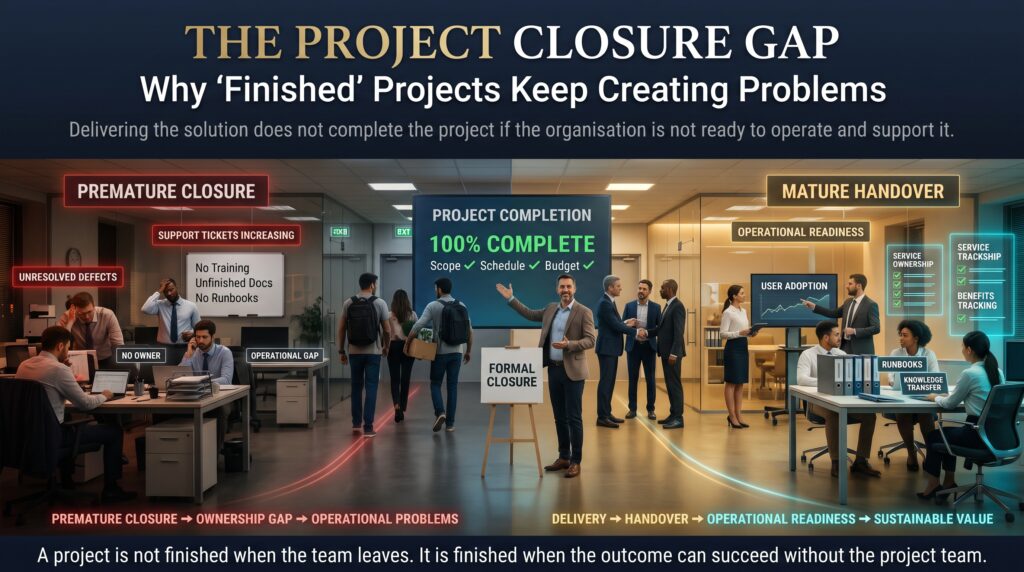

Project closure is the part of the project lifecycle that almost everyone agrees is important and almost nobody does properly. The status report says “complete”. The sponsor has moved on to the next priority. The team has been quietly reassigned. And yet, three weeks later, the help desk is flooded, the operations team can’t find the documentation, a supplier is still invoicing and someone is asking why the promised benefits haven’t appeared.
That mismatch between “delivered” and “actually finished” is the project closure gap. In this guide we’ll look at why it happens, what it costs, and how to close it with practical habits and recognised frameworks. Whether you’re managing projects in Melbourne, Sydney or anywhere else in Australia, these steps will help you finish projects in a way that stays finished.
What Is the Project Closure Gap?
It is the distance between the day a project is declared done and the day its outcomes are genuinely accepted, handed over, understood by the people who’ll run them and delivering the value they were meant to. When that distance is large, problems that “belong” to a finished project end up landing on whoever is left standing.
Proper project closure isn’t admin for its own sake. It’s the step that formally confirms that a project, phase or contract is complete, as the PM Global article on project closure puts it when it calls closure a forgotten art. Shipping the product or switching on the system is a milestone. True closure adds review, evaluation and a formal handover.
Why “Finished” Projects Keep Creating Problems
Nobody sets out to leave a mess. The gap opens up because of six very ordinary habits.
1. The Team Disbands Before the Work Is Really Done
Once the go-live date passes, people are pulled onto new work. The very individuals who understand the quirks of the solution disappear just as the first real-world issues start to appear.
2. Handover Is a Document Dump, Not a Transition
A folder of files isn’t a handover. Operations and support teams need training, walkthroughs, runbooks, escalation contacts and a chance to ask questions before the project team leaves. Without that, they inherit a system they don’t understand.
3. “Done” Means Delivered, Not Accepted
If the people who asked for the work never formally confirm they got what they needed, small disagreements about scope, quality and defects resurface weeks later, when nobody has the budget to fix them.
4. Lessons Learned Get Skipped or Filed and Forgotten
Everyone is tired at the end of a project, so the lessons learned session is the first thing to be cancelled. Or it happens, produces a long list, and the list never gets read again. Either way, the next project repeats the same mistakes.
5. Nobody Owns the Benefits After Go-Live
Benefits rarely show up on their own. Without someone responsible for measuring and chasing them, they quietly dissipate. The project was a success on paper and a disappointment in practice.
6. Loose Ends Pile Up
Open contracts, unreleased licences, active user accounts, unresolved risks, undocumented workarounds and budget codes that nobody has closed all become small, slow-burning problems that surface months after the project “finished”.
What a Proper Project Closure Process Includes
Different frameworks use different names, but a solid closure process covers the same core ground:
- Deliverable acceptance: formal sign-off from the people who requested the work.
- Handover and transition: training, documentation and support arrangements for the team that will run the outcome.
- Contract and procurement closure: supplier obligations settled, final invoices processed and agreements closed.
- Final reporting: performance compared with the original baseline for time, cost, scope and quality.
- Lessons learned: what worked, what didn’t and what the next project should do differently.
- Post-implementation review (PIR): a structured look at whether the project delivered what it promised. MindTools’ overview of project close activities describes it as a key part of administrative closure.
- Benefits review plan: who will measure benefits, when and against which targets.
- Archiving and release: records stored, access removed, resources released and the team recognised.
The Real Cost of Weak Project Closure
Skipping or rushing closure feels like saving time. In practice it just moves the cost somewhere less visible:
- Rework and support costs. Defects and unanswered questions land on operations teams with no project budget behind them.
- Repeated mistakes. Lessons that were never captured can’t be applied, so every project learns the same hard way.
- Lost benefits. Without tracking, the value promised in the business case drifts away.
- Damaged trust. Sponsors and users remember the messy aftermath more than the polished launch.
- Tired teams. People pulled back to fix “finished” projects can’t give their full attention to new ones.
- Compliance and audit risk. Missing records, unclosed contracts and unclear accountability create avoidable exposure.
Warning Signs You Have a Project Closure Gap
You can usually spot it before it becomes expensive. Watch for these red flags:
- Project teams are disbanded on go-live day with no support window
- Support or operations teams first hear about a new system in the week it launches
- No documented acceptance criteria, or acceptance that was never formally recorded
- Lessons learned sessions are routinely postponed or never held
- No one is named as responsible for benefits after the project ends
- Invoices, access rights and risks from “completed” projects are still active months later
How to Close the Project Closure Gap: 8 Practical Steps
- Plan closure from day one. Write closure criteria and handover requirements into your plan at the start, not the end, so they’re funded and scheduled.
- Define “done” in writing. Agree acceptance criteria with the sponsor and users early, and get formal sign-off against them.
- Run a staged handover. Involve operations and support teams before go-live, deliver training, share runbooks and confirm they feel ready to take ownership.
- Keep a short post-go-live support window. A defined hypercare period with named team members protects users and gives you real feedback while the project is still fresh.
- Hold a proper lessons learned session. Do it soon after delivery, invite the right mix of people, record owners and actions, and make sure the findings are reviewed at the start of the next project.
- Schedule the post-implementation and benefits reviews. Put a date in the diary for a few months after go-live, and make the sponsor accountable for the result.
- Tidy every loose end. Close contracts, remove access, update the risk and issue logs, archive records and close budget codes.
- Release the team deliberately. Thank people, share the outcomes and move them on in an orderly way rather than letting the project fade out.
How PRINCE2, PMP and AgilePM Approach Project Closure
You don’t have to invent a closure process from scratch. Recognised methods all treat closure as a deliberate, structured activity:
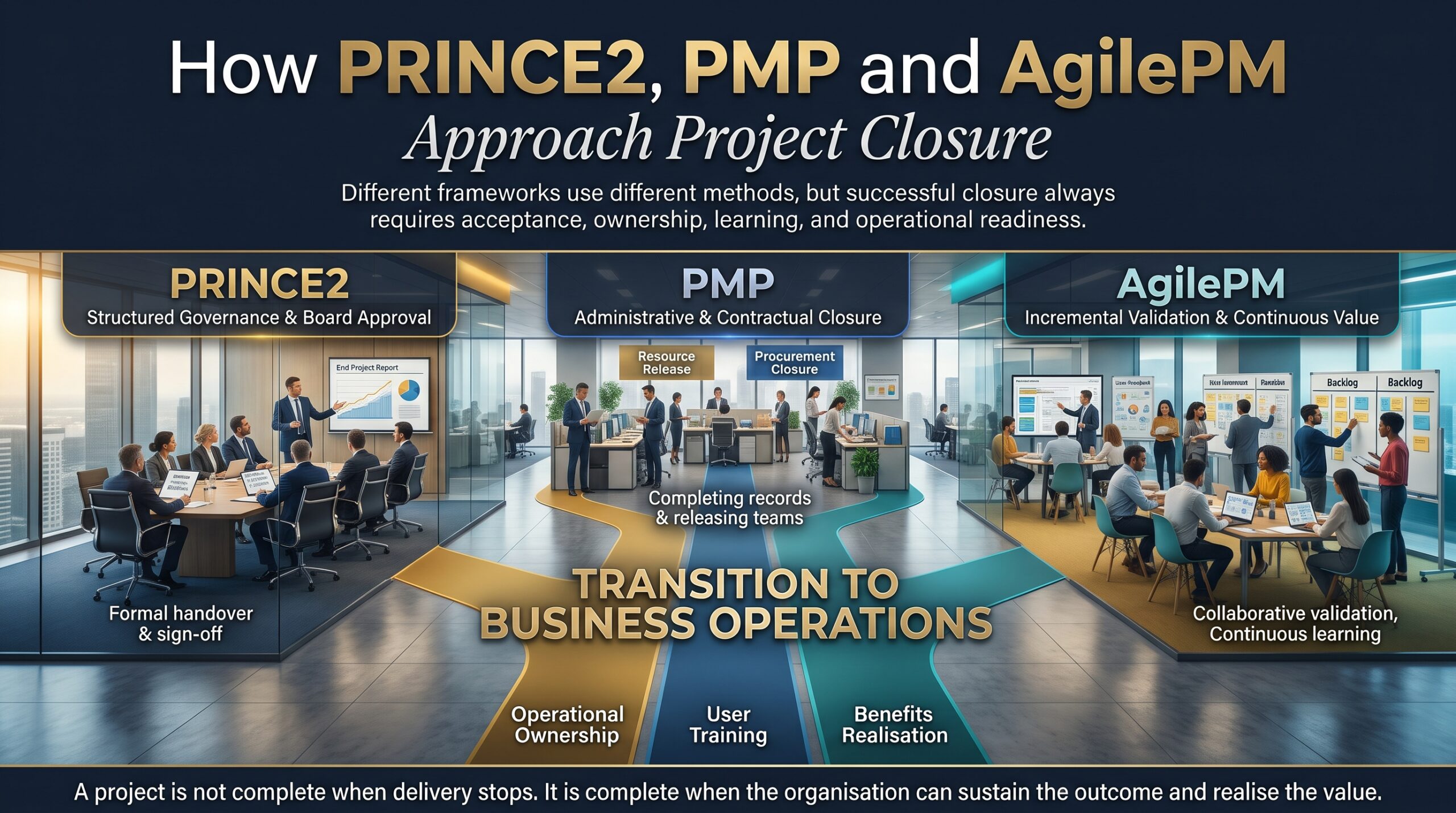
- PRINCE2 has a dedicated closing process built around confirming acceptance, handing over products, reviewing performance and recommending any follow-on actions. The official PRINCE2 guidance on capturing lessons learned and reviewing benefits stresses a thorough review session and mechanisms to measure benefits as they appear. Explore our PRINCE2 Project Management Foundation and PRINCE2 Project Management Practitioner
- PMP-aligned practice treats closing as a formal part of the project lifecycle: final acceptance, contract closure, knowledge transfer, archiving and lessons learned. See our Project Management Professional (PMP) certification
- AgilePM follows the project beyond delivery with a post-project phase focused on confirming benefits, which suits teams that release in increments. Start with AgilePM Foundation or build on it with AgilePM Practitioner.
Project Closure Across Australia: Melbourne, Sydney, Brisbane and Beyond
The gap shows up in every industry and every city. Government and defence programs in Canberra often involve formal acceptance and long operational lifecycles. Infrastructure, finance and technology projects in Sydney and Melbourne typically involve many vendors, which means a lot of contracts to close. Brisbane’s growing pipeline of major works makes clean handover to operators essential. In Perth and Adelaide, resources, engineering and health projects frequently hand over to specialist operations teams that need solid training and documentation.
Our project management training is available for professionals in Adelaide, Brisbane, Canberra, Melbourne, Perth and Sydney, with flexible online and in-house options. See all project management training locations to find what suits you.
Project Management Certifications That Strengthen Project Closure
Knowing why closure matters is one thing. Having a repeatable, recognised method is another. These certification pathways are a good place to start:
- PRINCE2 Project Management Foundation: a structured introduction to controlled project delivery, including how projects are formally closed.
- PRINCE2 Project Management Practitioner: apply PRINCE2 to real scenarios, from stage boundaries to closing a project.
- Project Management Professional (PMP) certification: a globally recognised credential for experienced project leaders.
- AgilePM Foundation and AgilePM Practitioner: Agile delivery with governance, including post-project benefit confirmation.
- Project Planning & Control: sharpen the planning and tracking habits that make clean closure possible.
- BCS IS Project Management Foundation and CompTIA Project+: well suited to IT and technology project teams.
Not sure where to begin? Browse all project management certifications, check the FAQs, read more on our project management blog, learn about us or contact our team.
Project Closure FAQs
What is project closure in project management?
It is the final stage of a project, where deliverables are formally accepted, handed over, contracts are closed, lessons are captured and the team is released.
Why is project closure important?
It confirms the work is genuinely complete, transfers knowledge to the people who will run the outcome, captures lessons for future projects and creates a clear point for reviewing benefits.
What should be in a project closure checklist?
At a minimum: deliverable acceptance, handover and training, contract closure, final reporting, a lessons learned session, a post-implementation review, a benefits review plan, archiving and team release.
When should lessons learned be captured?
Ideally throughout the project and again in a dedicated session soon after delivery, while memories are fresh. The findings should be stored somewhere future teams will actually look.
Which certifications cover project closure?
PRINCE2, PMP-aligned training and AgilePM all address closing a project in a structured way, so each is a good choice depending on your role and preferred approach.
Final Thoughts: Finish Projects So They Stay Finished
A project isn’t finished when the last deliverable ships. It’s finished when it has been accepted, understood, supported and is producing the value that justified it. Treat project closure as a planned, funded phase rather than a courtesy, and the gap between “done” and “truly done” shrinks fast.
Ready to build those skills? Get in touch or call 1300 649 299 to find the right certification for you or your team.