

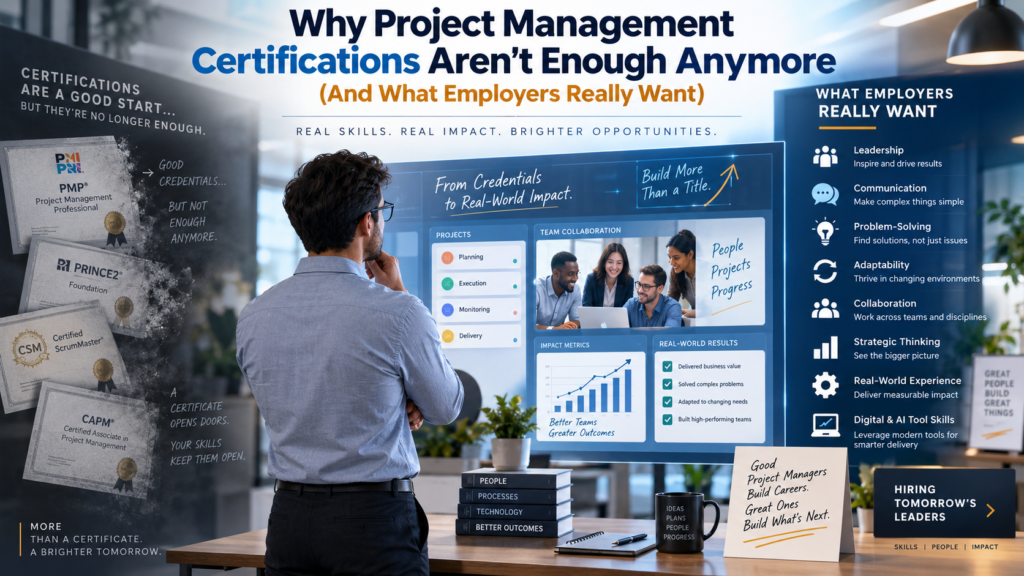

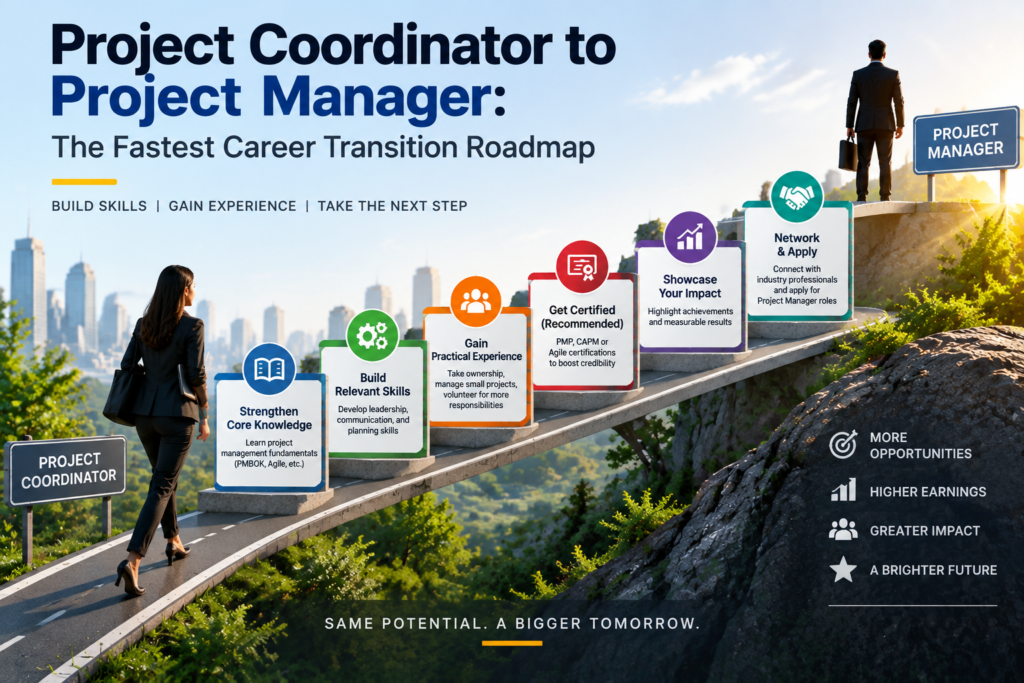
Project leadership skills, not certifications or technical know-how alone, are what separate a senior project coordinator from a promoted Project Manager or Program Director. Every year, thousands of highly competent project professionals across Australia get passed over for promotion, and it’s rarely because they lack technical ability. It’s because they haven’t closed the project leadership gap between running tasks and leading people.
If you can build a flawless Gantt chart, manage a risk register in your sleep, and recite the PMBOK Guide from memory, but you’re still watching less technically skilled colleagues get promoted ahead of you, this article explains exactly why, and what to do about it.
What Is the Project Leadership Gap?
The project leadership gap is the difference between technical project management competence (scheduling, budgeting, risk tracking, methodology knowledge) and the interpersonal, strategic, and influence-based capabilities that senior roles actually demand. It shows up when a technically brilliant project manager struggles to get executive buy-in, manage a difficult stakeholder, or lead a team through ambiguity.
Hiring panels and promotion committees rarely say this out loud, but it’s consistently the deciding factor. A 2023 Gallup workplace study found that most organisations promote based on demonstrated performance in a current role, yet the skills that make someone excellent at execution are often different from the skills that make them a trusted leader. Project management is no exception, and arguably one of the clearest examples.
Why Technical Mastery Alone Doesn’t Get You Promoted
Technical skills get you hired. Project leadership skills get you promoted. Here’s why the two are not interchangeable.
Certifications Prove Competence, Not Command
A PMP or PRINCE2 certification tells an employer you understand project management frameworks, governance, and process. It does not, on its own, demonstrate that you can hold a room, resolve a conflict between two department heads, or make a call when the data is incomplete and the deadline isn’t moving. Certifications are the entry ticket; leadership behaviour is what gets you through the door marked “promotion.”
The Individual Contributor Trap
Many project managers get promoted into their first PM role because they were an outstanding analyst, engineer, or coordinator. That same instinct, being the person who personally solves the problem, becomes a liability at the next level. Senior roles reward people who can develop capability in others, delegate meaningfully, and step back from the keyboard to manage the system. Staying the best individual technical performer in the room is often the exact reason someone plateaus.
What Executives Actually Evaluate Before Promoting a PM
When leadership teams assess a project manager for a senior or program-level role, they are typically looking past the project plan and asking: Can this person manage upward? Can they influence stakeholders with no direct authority over them? Do people trust their judgement under pressure? Can they represent the project’s story to a board or client with confidence? These are project leadership skills, and they are learned, not accidental.
The Project Leadership Skills That Actually Get You Promoted
If you’re aiming for your next promotion, these are the capabilities to deliberately build alongside your technical project management skills.
- Stakeholder management and influence — the ability to align people who don’t report to you, including senior executives, around a shared outcome.
- Strategic communication — translating project detail into business impact for boards, sponsors, and clients, not just status reports.
- Emotional intelligence — reading team morale, managing conflict early, and staying composed when a project is under pressure.
- Decision-making under ambiguity — making a defensible call with 70% of the information, rather than waiting for certainty that never arrives.
- Conflict resolution — mediating disagreements between stakeholders, vendors, or team members without escalating every issue upward.
- Change leadership — helping teams and stakeholders adopt new processes and technology, not just delivering the technical rollout.
- Business and commercial acumen — understanding how the project ties to ROI, strategy, and organisational priorities, not just scope and schedule.
Technical Skills vs Project Leadership Skills: A Side-by-Side Comparison
Both sets of skills matter, but they solve different problems. Promotion decisions are almost always made on the right-hand column.
| Technical Project Management Skills | Project Leadership Skills |
| Building schedules, WBS, and budgets | Setting direction and priorities under ambiguity |
| Tracking risks and issues | Anticipating stakeholder resistance before it surfaces |
| Running status meetings | Building trust and psychological safety in the team |
| Applying a methodology (PRINCE2, Agile, Waterfall) | Adapting the approach to the people and politics involved |
| Reporting progress to the sponsor | Influencing decisions the project doesn’t control |
| Managing the project plan | Managing the project’s narrative and stakeholder confidence |
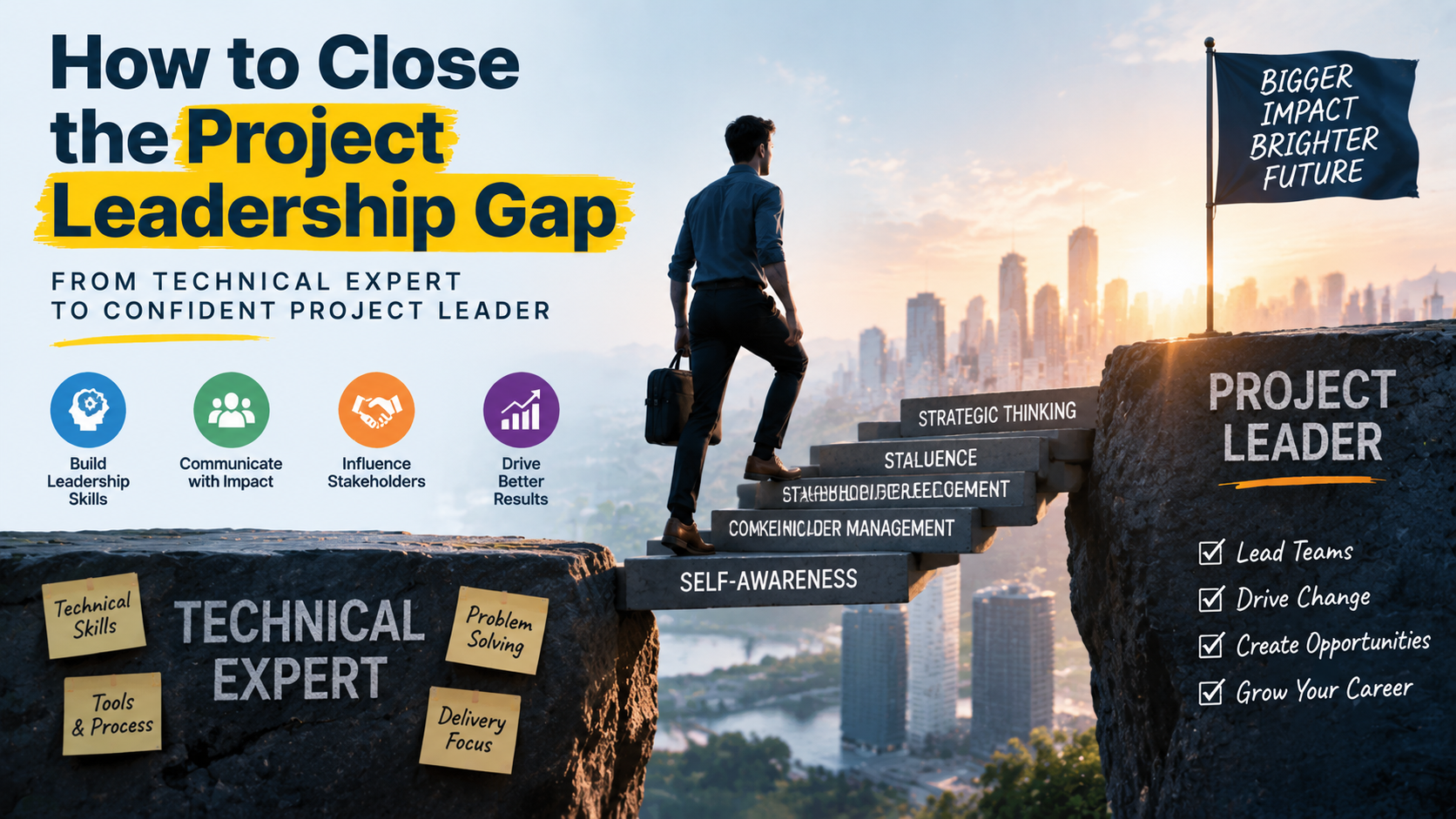
How to Close the Project Leadership Gap
Closing the project leadership gap is a deliberate process, not something that happens automatically with years of experience. Here’s a practical five-step approach.
- Get formal leadership exposure inside your certification. Modern PRINCE2 and PMP training increasingly builds in stakeholder engagement, governance, and leadership modules. Choose a course that goes beyond process and actively develops these behaviours.
- Ask for stretch assignments, not just bigger projects. Volunteer to lead a cross-functional initiative, present to the executive team, or manage a difficult stakeholder relationship. Visibility in ambiguous, high-stakes situations is what promotion committees remember.
- Build your emotional intelligence deliberately. Ask trusted colleagues for direct feedback on how you handle pressure and conflict. EI is trainable, but only if you actively seek the feedback loop.
- Find a mentor and start mentoring others. Leadership is demonstrated by how you develop other people, not just how you manage your own workload.
- Learn the business, not just the methodology. Understand how your projects connect to revenue, strategy, and customer outcomes. Project managers who can speak the language of the business get pulled into strategic conversations.
Certifications That Signal Leadership Readiness
The right certification won’t replace lived leadership experience, but it does two things: it structures your learning, and it signals to a promotion panel that you’ve deliberately invested in the skills the role requires.
For a full breakdown of the leading options, see our comparison guide: PRINCE2 vs PMP: Which Project Management Certification Should You Choose in Australia?, and our complete Project Management Certifications Guide covering PMP, PRINCE2, Agile, and Scrum.
- PMP (Project Management Professional) globally recognised, strong on leading complex, high-stakes projects and stakeholder management.
- PRINCE2 and PRINCE2 Agile widely used across Australian government and enterprise, strong on governance and structured decision-making.
- Certified ScrumMaster (CSM) builds servant-leadership and team facilitation skills for Agile environments.
- Change management training directly builds the change leadership capability that promotion panels look for.
See our full ranked breakdown in Top Project Management Certifications in Australia for 2026, and if you’re weighing up the jump from a coordinator role first, read Project Coordinator vs Project Manager: How to Make the Transition Successfully.
Explore accredited PRINCE2, PMP, and Agile leadership training through Logitrain, Australia’s project management training provider.
Project Leadership Training Across Australia
Project leadership skills are in demand across every major Australian market, and structured training is available in-person and online nationally, including:
- Sydney — strong demand for PMP and PRINCE2-qualified leaders across finance, construction, and government projects.
- Melbourne — high volume of program and portfolio leadership roles in infrastructure and technology.
- Brisbane — growing demand tied to infrastructure and major event delivery programs.
- Perth — resources and energy sector projects requiring strong stakeholder and risk leadership.
- Adelaide — defence, health, and government project leadership pipelines.
- Canberra — federal government program governance and stakeholder management roles.
Training is delivered as instructor-led online and classroom courses through Logitrain, with certification pathways detailed on projectmanagementcertifications.com.au.
Frequently Asked Questions
Why don’t technical skills alone get you promoted in project management?
Because promotion decisions are made on evidence of leadership: influence without authority, stakeholder trust, and sound judgement under pressure, not on scheduling or process accuracy alone.
What project leadership skills matter most for promotion?
Stakeholder management, strategic communication, emotional intelligence, decision-making under ambiguity, and business acumen consistently rank highest with promotion panels.
Can a certification alone close the project leadership gap?
No. A certification like PMP or PRINCE2 builds the framework and signals commitment, but leadership skills are built through real stretch assignments, feedback, and mentoring alongside it.
How long does it take to move from project coordinator to a leadership-level PM role?
Most professionals see a realistic path over 12 to 24 months when they combine certification, deliberate stretch assignments, and structured feedback on leadership behaviours.
Is PRINCE2 or PMP better for building project leadership skills?
Both build strong leadership foundations. PRINCE2 emphasises governance and structured decision-making; PMP places more weight on stakeholder and team leadership across complex projects. See our full comparison for a detailed breakdown.
Final Thoughts
The project leadership gap is real, measurable, and closable. Technical project management skills will always be the foundation, but the professionals who get promoted are the ones who deliberately build project leadership skills alongside them: influence, communication, judgement, and the ability to develop other people. Start by identifying the one leadership skill on this list you’re weakest in, and build a 90-day plan to strengthen it.