



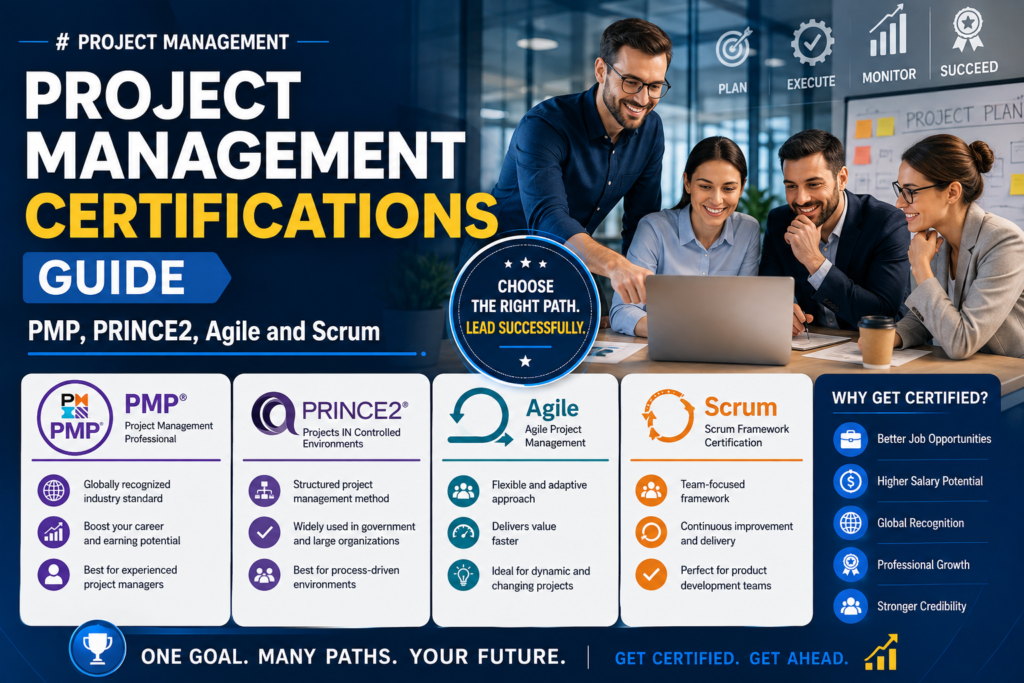
This project management certifications guide exists because the four biggest names in the field PMP, PRINCE2, AgilePM, and Scrum all claim to be “the” standard, and job ads rarely explain which one actually matches the role you want. Some are process-heavy and structured, some are lightweight and iterative, and some sit somewhere in between. Below, we break down what each certification actually covers, who it suits, and how to choose a path instead of guessing.
Project management remains one of the most transferable skill sets in the job market, valued across construction, IT, healthcare, finance, and government. But not every certification suits every industry or working style, which is exactly why this comparison matters before you commit time and money to studying one.
Why a Project Management Certification Still Matters in 2026
Even as AI tools speed up scheduling, reporting, and documentation, someone still has to own scope, budget, risk, and stakeholder alignment and employers increasingly want proof of that capability, not just years of informal experience. A recognised project management certification signals that you understand a structured methodology rather than managing projects by instinct, which matters most when you’re moving into a new industry or a more senior delivery role.
PMP: The Global Standard for Experienced Project Managers
The Project Management Professional (PMP) certification, governed by PMI, is the most widely recognised project management credential globally. PMP is process-and-outcome focused, covering the full project lifecycle initiation, planning, execution, monitoring, and closing across predictive, agile, and hybrid approaches.
Best for: professionals who already have several years of project management experience and want the certification with the broadest international recognition, particularly in large enterprise, government, and multinational organisations.
Note: PMP has formal eligibility requirements around project management experience and education, so it’s typically not the first certification for someone brand new to the field.
PRINCE2: The Structured, Process-Driven Framework
PRINCE2 Foundation and PRINCE2 Practitioner follow a highly structured, process-based methodology that’s especially dominant in the UK, Europe, and Australian government and corporate environments. PRINCE2 breaks projects into defined stages with clear roles, governance, and controlled decision points making it a strong fit for organisations that need consistent, auditable project delivery.
Best for: professionals working in government, corporate governance-heavy environments, or organisations that require a standardised, repeatable project delivery framework.
For teams blending structure with flexibility, PRINCE2 Agile Foundation and PRINCE2 Agile Practitioner combine PRINCE2’s governance model with agile delivery techniques.
AgilePM: Structured Agile for Complex Projects
AgilePM Foundation and AgilePM Practitioner apply agile principles within a governed framework, based on the DSDM (Dynamic Systems Development Method) approach. Unlike pure Scrum, AgilePM is designed for larger, more complex projects that still need documented governance, making it popular with organisations that want agile speed without losing project controls.
Best for: project managers working in agile environments who also need to satisfy formal governance, reporting, or compliance requirements.
Scrum: The Lightweight Framework for Iterative Delivery
Scrum isn’t a full project management methodology it’s a lightweight framework for managing iterative, incremental work, most commonly used in software development and product teams. Scrum organises work into short cycles called sprints, with defined roles (Scrum Master, Product Owner, Development Team) and ceremonies (sprint planning, daily stand-ups, retrospectives). Many project managers pair Scrum knowledge with a broader certification like AgilePM or PRINCE2 Agile, since Scrum alone doesn’t cover the governance, budgeting, and stakeholder management skills a full project management role requires.
Best for: professionals working directly inside agile software or product teams who need to understand sprint-based delivery, even if their formal certification is PRINCE2, AgilePM, or PMP.
PMP vs PRINCE2 vs AgilePM vs Scrum: Quick Comparison
| PMP | PRINCE2 | AgilePM | Scrum | |
| Approach | Predictive, agile & hybrid | Structured, stage-gated | Governed agile | Iterative, sprint-based |
| Best fit | Experienced PMs, enterprise & global roles | Government, corporate governance | Complex agile projects needing controls | Software/product teams |
| Prerequisites | Formal experience & education required | None for Foundation | None for Foundation | Varies by provider |
| Recognition | Global | Strong in UK/EU/AU government | Growing, especially AU/UK | Global in software/tech |
How to Choose the Right Project Management Certification
- Check what your target employer actually asks for. Government and enterprise roles often specify PRINCE2 or PMP by name; tech and product roles often expect Agile or Scrum familiarity.
- Consider your experience level. PMP requires documented experience; PRINCE2 Foundation and AgilePM Foundation don’t, making them accessible starting points.
- Think about your industry’s delivery style. Highly regulated, governance-heavy industries lean PRINCE2; fast-moving product and software teams lean Agile/Scrum.
- Stack certifications over time. Many senior project managers hold PRINCE2 or PMP alongside AgilePM or Scrum knowledge to cover both structured and agile delivery environments.
If you’re weighing up an IT-specific entry point instead, our CompTIA Project+ Certification (PK0-005) is a practical, vendor-neutral alternative for professionals starting out in IT project coordination.
Live Project Management Certification Training Across Australia
All certifications covered in this guide are available as live, instructor-led training, with flexible weekday, evening, and weekend delivery. Training is available for professionals based in:
Browse the full certifications list or contact a training advisor to confirm which certification matches your industry and experience level. For official PMP exam requirements, see the Project Management Institute.
FAQ: PMP, PRINCE2, Agile and Scrum
Which project management certification is best for beginners?
PRINCE2 Foundation, AgilePM Foundation, and CompTIA Project+ have no formal experience prerequisites, making them the most accessible starting points. PMP requires documented project management experience, so it’s usually a later-career certification.
Can I hold both PRINCE2 and PMP?
Yes, and many senior project managers do. PRINCE2 demonstrates process and governance expertise, while PMP adds broader international recognition and covers agile and hybrid approaches alongside predictive methods.
Is Scrum a certification or a methodology?
Scrum is a lightweight framework, not a full project management methodology. It’s typically learned alongside a broader certification like AgilePM or PRINCE2 Agile rather than used as a standalone project management qualification.
Do these certifications expire?
PMP requires ongoing professional development units (PDUs) to maintain. PRINCE2 and AgilePM certifications don’t expire in the same renewal-based way, though staying current with framework updates is recommended.
Which certification pays more, PMP or PRINCE2?
This varies by industry and region. PMP tends to carry a premium in enterprise and multinational organisations, while PRINCE2 is often specifically requested — and equally valued — in Australian government and corporate governance-heavy roles.
Ready to Choose Your Project Management Certification?
Whether you’re leaning toward PMP, PRINCE2, AgilePM, or building Scrum knowledge alongside a formal certification, live instructor-led training gets you exam-ready faster than self-study alone. Talk to a training advisor or call 1300 649 299 to confirm the right certification path for your industry and city.