




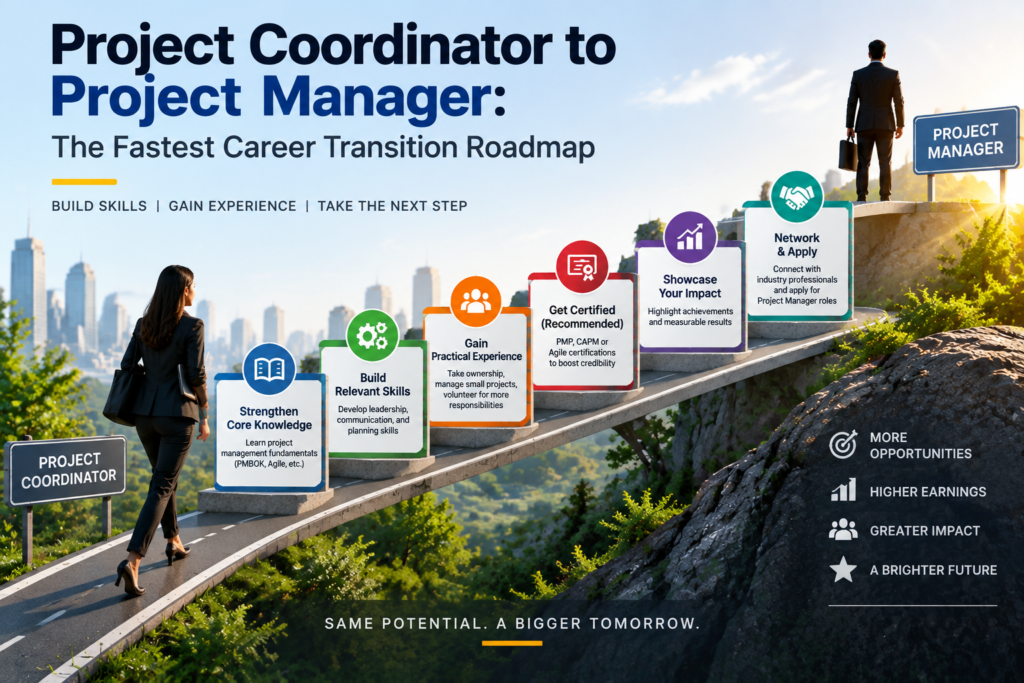
Moving from Project Coordinator to Project Manager is one of the most achievable promotions in the corporate world if you follow the right sequence. Coordinators already sit close to the action: updating schedules, chasing action items, tracking budgets and liaising with stakeholders in cities like Melbourne, Sydney and Brisbane. What separates a coordinator who stalls for years from one who is promoted within 18 months isn’t luck it’s a deliberate roadmap of skills, certifications and visible ownership.
This guide breaks down the fastest realistic path from Project Coordinator to Project Manager, including the certifications employers actually check for, the Australian salary jump you can expect, and the exact responsibilities to volunteer for at each stage.
Stage 1: What a Project Coordinator Needs to Master First
Before you can make the leap from Project Coordinator to Project Manager, you need to be excellent at the coordinator fundamentals not just competent. Hiring managers promote the coordinator who already looks like they’re doing half the PM’s job.
Core skills to prove early
- Building and maintaining project schedules, RAID logs and status reports
- Running effective meetings and following up on action items without being chased
- Basic budget tracking, purchase orders and vendor coordination
- Clear, confident stakeholder communication, both written and verbal
A structured Project Management Certification at the foundation level is the fastest way to formalise this knowledge, because it gives you a shared vocabulary scope, baseline, milestone, risk register that project managers expect you to already know.
Stage 2: Certification The Fastest Lever from Project Coordinator to Project Manager
Certification is the single biggest accelerator in the Project Coordinator to Project Manager transition. It proves you understand a recognised methodology, not just the terminology you’ve picked up on the job, and it is usually the tie-breaker when two internal candidates are being compared for a promotion.
Recommended certification pathway
- PRINCE2 Project Management Foundation — the most widely requested entry-level credential in Australian job ads. View the course
- CompTIA Project+ Certification — a vendor-neutral option that’s ideal for coordinators moving into IT or technical projects. View the course
- AgilePM Foundation — essential if your organisation runs Agile or hybrid delivery. View the course
- PRINCE2 Project Management Practitioner — the natural next step once you’re ready to own a project end-to-end. View the course
Later, once you are running full projects, most professionals add the globally recognised Project Management Professional (PMP) from PMI, or continue the PRINCE2 pathway through Axelos, both of which are recognised by employers across Perth, Adelaide and Canberra, and accepted by the Australian Institute of Project Management for continuing professional development.
Stage 3: Taking on Real Project Manager Responsibilities
Certification opens the door, but the actual Project Coordinator to Project Manager transition happens when you start owning outcomes instead of just tracking tasks. This is the stage where you volunteer to run a small work stream end-to-end, present status updates directly to sponsors, and start making scope and risk decisions rather than just logging them.
Typical Australian salary range
- Project Coordinator: AU$70,000 – AU$90,000
- Junior Project Manager: AU$95,000 – AU$115,000
- Project Manager (mid-level): AU$115,000 – AU$140,000
The jump from coordinator to project manager typically adds AU$20,000–$30,000 to your base salary, which is why employers expect a certification, a portfolio of delivered work, and demonstrated ownership before approving the title change.
Stage 4: Leading Full Projects Independently
Once you’re formally a Project Manager, the next 2–4 years are about running full projects independently — owning the budget, the schedule, the risk register and the relationship with the project sponsor. This is also when most professionals pursue the Project Management Professional (PMP) Certification, widely regarded as the gold-standard credential for mid-to-senior project managers.
What changes at this stage
- You own the business case, budget and benefits realisation, not just the schedule
- You negotiate directly with vendors and manage contracts
- You report project health and risk exposure straight to executives
Stage 5: Senior Project Manager and Program Manager Roles
The natural continuation after Project Coordinator to Project Manager is Senior Project Manager or Program Manager overseeing multiple related projects, mentoring junior coordinators, and shaping portfolio-level strategy. Professionals at this level typically combine a PMP or PRINCE2 Practitioner qualification with several years managing six- and seven-figure project budgets.
- Senior Project Manager: AU$140,000 – AU$165,000
- Program Manager: AU$160,000 – AU$190,000+
Project Coordinator to Project Manager Roadmap at a Glance
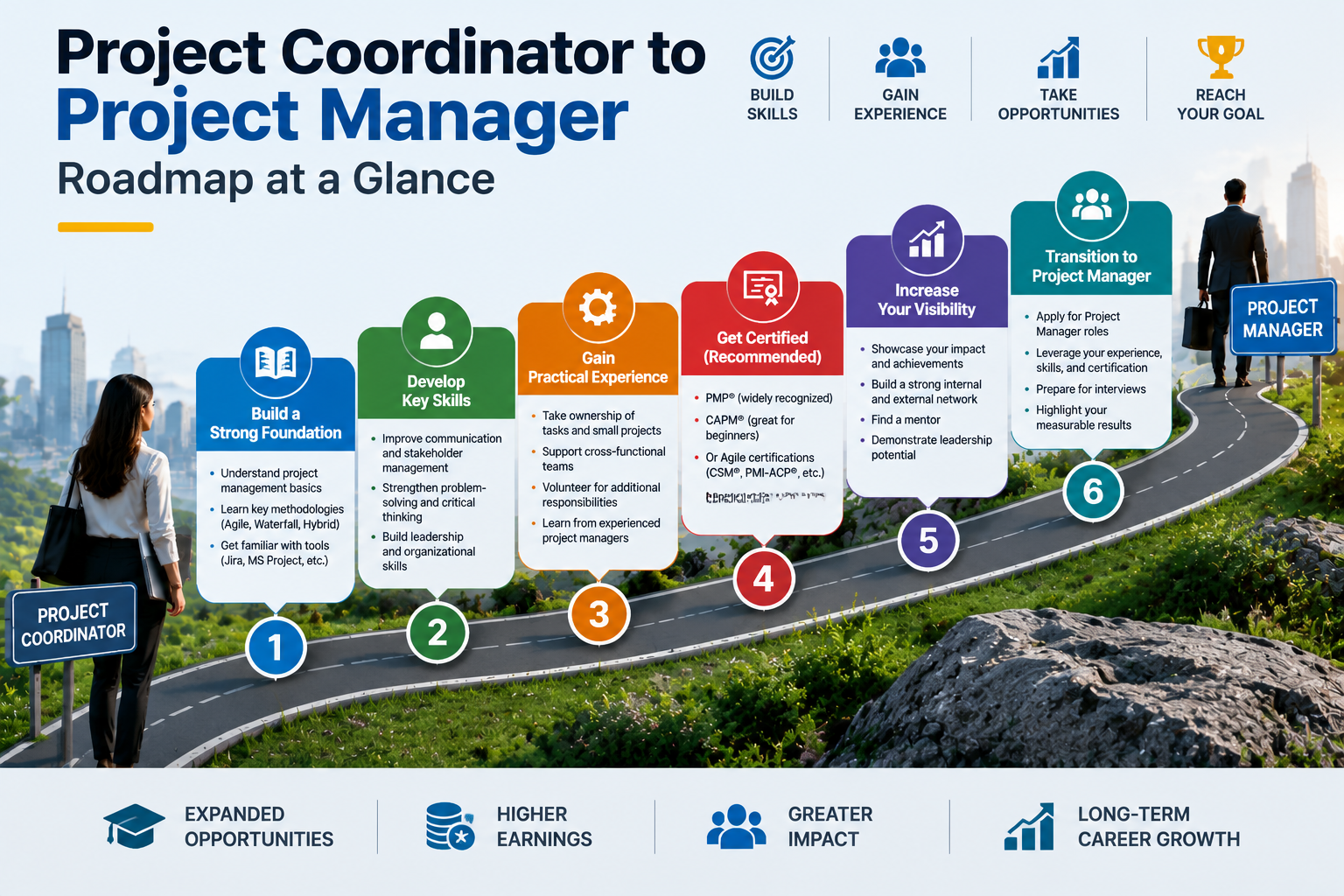
| Stage | Focus | Typical Timeframe |
| Project Coordinator | Schedules, RAID logs, reporting | 0–1 year |
| Certified Coordinator | PRINCE2 / Project+ / AgilePM Foundation | 1–2 years |
| Junior Project Manager | Own a work stream end-to-end | 2–3 years |
| Project Manager | Full project ownership, PMP study | 3–5 years |
| Senior PM / Program Manager | Multi-project portfolio leadership | 5+ years |
FAQs About Moving from Project Coordinator to Project Manager
How long does it take to go from Project Coordinator to Project Manager?
Most professionals make the move in 18 months to 3 years, provided they combine a recognised certification with visible ownership of real project work streams.
Do I need PRINCE2 or PMP to become a Project Manager?
Neither is legally required, but most Australian employers shortlist certified candidates first. PRINCE2 Foundation is the most common starting point, with PMP typically pursued once you’re managing projects independently.
Can a Project Coordinator move straight into Agile project delivery?
Yes. Many coordinators move from traditional waterfall coordination into Agile or hybrid delivery by adding an AgilePM Foundation certification alongside their existing project experience.
Start Your Project Coordinator to Project Manager Journey Today
Ready to make the move? Explore our Project Management Certifications or contact our team to find the right training pathway for your city, including Melbourne, Sydney, Brisbane, Perth, Adelaide and Canberra.