


The benefits ownership gap is the quiet reason so many successful projects fail to pay off. The system goes live, the building opens, the new process is signed off, and the project team gets its round of applause. Six months later, nobody can say whether the numbers in the business case ever showed up. That space between handover and accountability is where project value disappears, and it often costs an organisation more than a blown schedule ever will.
If you’ve worked on a project that was delivered on time and on budget but somehow changed very little for the business, you’ve already met this problem. This guide explains what the gap is, why it happens, how to spot it and what you can do to close it. We’ll also look at how project management certifications such as PRINCE2, AgilePM and PMP give you the tools to manage benefits properly, whether you’re based in Sydney, Melbourne, Brisbane or anywhere else in Australia.
What Is the Benefits Ownership Gap?
Every project produces three different things, and people mix them up constantly. Outputs are the things you build or deliver, such as a new app, a refurbished ward or a migrated database. Outcomes are the changes those outputs make possible, such as staff using the app, patients moving through the ward faster or teams working from one source of truth. Benefits are the measurable value those changes create, like lower processing costs, higher revenue, fewer errors or better customer satisfaction.
A project team can control outputs. It can influence outcomes. But benefits usually appear months or even years after the project has closed, in a part of the business the project manager doesn’t run. The benefits ownership gap is the period, and the accountability vacuum, between delivery and the point where someone with real authority is responsible for making sure the promised value turns up.
Put simply, the project finishes while the benefits are still in transit, and there’s nobody at the other end to collect them.
Why Project Value Disappears After Delivery
There’s rarely a single villain. The benefits ownership gap opens up because of a handful of structural habits that most organisations share.
The project closes before the benefits arrive
Project governance is built around a finish line. Once the deliverables are accepted, the budget is closed, the team is released and the project board is dissolved. Benefits run on a different clock. A new procurement system might not show real savings until a couple of quarters after go-live, once old habits have been retired. By then, the structure that was watching the value has already been dismantled.
The project manager moves on
Project managers are usually measured on delivery and quickly reassigned to the next initiative. That’s reasonable, but it means the person who understands the business case best walks away at exactly the moment it needs defending. Institutional memory leaves with them.
Business-as-usual teams never agreed to the benefits
Here’s a common pattern. A sponsor promises a 15 per cent reduction in call handling time. The operations manager who actually runs the call centre was never asked, doesn’t have it in their KPIs and has a dozen other priorities. When the project hands over, the benefit is effectively an orphan. Nobody refused to own it. Nobody was ever asked.
Nobody captured a baseline
You can’t prove a 20 per cent improvement if you never recorded where you started. Many projects skip baseline measurement because it feels like extra work before the real work begins. Later, when leaders ask whether the project worked, the honest answer is “we think so”. Without a baseline, the benefits ownership gap is invisible, because there’s nothing to compare the results against. That’s not a comfortable place for a business case to end up.
Success is defined as on time and on budget
Traditional scorecards reward schedule and cost performance because they’re easy to count. They say very little about whether the organisation is actually better off. A project can tick every delivery box and still leave the benefits ownership gap wide open. The Project Management Institute has repeatedly highlighted the importance of linking projects to strategy and measurable value, and that’s the point where high-performing project organisations separate themselves from the rest.
Warning Signs of a Benefits Ownership Gap in Your Organisation
Not sure whether this applies to you? Watch for these signals:
- The business case is filed away after approval and never opened again.
- Benefits are described in vague terms such as “improved efficiency” or “better experience”.
- Nobody outside the project team can name the person accountable for each benefit.
- The closure report talks about deliverables, not measured results.
- Post-implementation reviews are skipped, postponed or reduced to a lessons-learned workshop.
- Leaders keep approving new projects without knowing what the last ones actually returned.
If three or more of those feel familiar, the benefits ownership gap is probably costing you value right now.
A Realistic Example: The CRM Rollout That Delivered Everything Except the Value
Here’s an illustrative scenario that mirrors what happens across industries. A mid-sized financial services firm in Melbourne approves a customer relationship management platform. The business case rests on two promises: shorter sales cycles and higher cross-sell revenue.
The project is, by any normal standard, a triumph. It lands two weeks early, comes in under budget and passes user acceptance testing. The project manager hands over the keys, files a tidy closure report and moves to a new programme.
Twelve months later, the sales cycle hasn’t moved. Adoption is patchy because team leaders never changed their weekly reporting to use the new dashboards. Nobody owns cross-sell revenue as a target for the platform, and the original baseline lived in a spreadsheet on a former employee’s laptop. The CFO asks what the investment returned, and the room goes quiet.
Nothing in that story is a delivery failure. Every task was completed. It’s a textbook benefits ownership gap, and it’s exactly the kind of problem that structured benefits management is designed to prevent.
How to Close the Benefits Ownership Gap: 7 Practical Steps

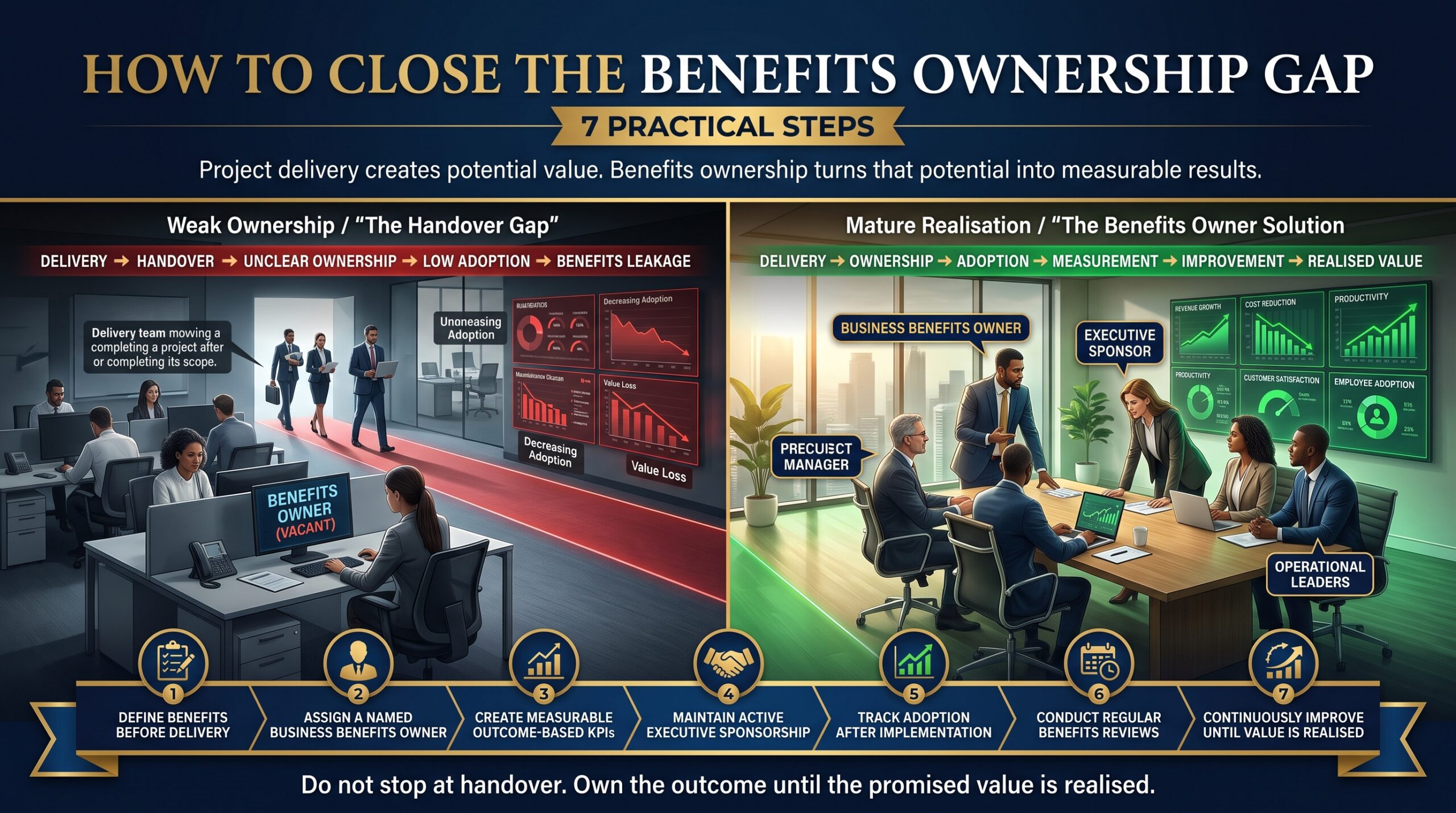
1. Name a benefits owner before the project is approved
Every benefit needs a named individual with the authority to change how the business operates. Not a team, not a committee and not “the business”. In PRINCE2 terms, the executive carries overall accountability for the business case, but day-to-day benefit ownership should sit with the manager whose area will actually change. If that manager hasn’t agreed to own it, the benefit isn’t ready to be promised. This is the single most effective way to close the benefits ownership gap.
2. Write benefits in measurable terms
Replace “improve customer experience” with “lift customer satisfaction from 72 to 80 within nine months of go-live”. A good benefit statement has a metric, a baseline, a target and a date. If you can’t measure it, it’s an aspiration, not a benefit.
3. Capture the baseline early
Record current performance before the project changes anything. Store it somewhere permanent and accessible, and have the benefit owner sign it off. This single step makes later conversations about success far less painful.
4. Build a benefits realisation plan that outlives the project
A benefits realisation plan sets out which benefits will be measured, how, by whom and when. Crucially, it extends beyond project closure. Include review points at three, six and twelve months after go-live, and hand the plan to the benefit owner as part of formal handover rather than as an afterthought.
5. Embed benefits into business-as-usual targets
Benefits survive when they show up in performance agreements, team scorecards and operational reporting. If the call centre manager is measured on handling time, the handling-time benefit has a home. If it only lives in project documents, it will fade quietly.
6. Schedule post-project benefit reviews
PRINCE2 includes post-project reviews because many benefits can only be assessed after the project has finished. Put those review dates in calendars before the team disbands, and make sure someone with authority is responsible for convening them.
7. Report benefits, not just progress
Steering committees love schedule charts. Add a simple benefits tracker next to them showing the benefit, the owner, the baseline, the target, the latest result and a red-amber-green status. When leaders see value tracked with the same rigour as time and cost, behaviour changes.
Benefits Realisation Management and the Frameworks That Support It
Benefits realisation management is the discipline of identifying, planning, tracking and realising the benefits a project promises. It isn’t a separate methodology so much as a mindset that sits inside good governance. Several recognised frameworks build it in, and each one helps close the benefits ownership gap in a slightly different way.
- PRINCE2: The Business Case is one of the seven themes, and the method expects a benefits management approach and reviews after closure. Start with PRINCE2 Project Management Foundation and progress to PRINCE2 Project Management Practitioner.
- AgilePM and PRINCE2 Agile: Keep the business case and value delivery in view while teams work iteratively. See AgilePM Foundation, AgilePM Practitioner and PRINCE2 Agile Foundation.
- PMP: Covers the business environment, including how projects deliver benefits and value to the organisation. Explore the Project Management Professional (PMP) Certification.
- CompTIA Project+ and BCS IS Project Management: Useful for technology teams where systems are delivered fast and benefits are easy to lose. See CompTIA Project+ and BCS IS Project Management Foundation.
For standards and professional guidance, the Australian Institute of Project Management, the Association for Project Management and the official PRINCE2 site are all worth bookmarking. Public sector readers may also want to see how the Australian National Audit Office examines whether government programs achieve their intended outcomes.
Skills Project Managers Need to Close the Benefits Ownership Gap
Closing the benefits ownership gap isn’t about adding paperwork. It’s about a handful of skills that many project managers only develop late in their careers:
- Business case thinking: Understanding where the value comes from and how it will be measured.
- Stakeholder engagement: Getting benefit owners on board early, not at handover.
- Change management: Helping people adopt new ways of working, because unused deliverables produce no benefits.
- Governance and assurance: Keeping benefits on the agenda after the project board disbands.
- Measurement and reporting: Turning data into simple, honest benefits updates.
These are the same capabilities developed through structured training, including our Project Planning & Control course and the wider range of project management certifications.
The Benefits Ownership Gap Across Australian Cities
The benefits ownership gap shows up everywhere, but the pressure points differ by location and industry.
- Sydney: Finance, technology and large transformation programmes where benefits are often tied to cost and revenue targets. See project management training in Sydney.
- Melbourne: Healthcare, technology, education and construction projects that need clear benefit owners across complex stakeholder groups. See project management certifications in Melbourne.
- Brisbane: A growing infrastructure pipeline as the city prepares for the 2032 Olympic and Paralympic Games. See project management training in Brisbane.
- Canberra: Federal agencies where programs face close scrutiny over whether they deliver their intended outcomes. See project management courses in Canberra.
- Perth: Resources, energy and engineering projects where long delivery cycles make benefit tracking essential. See project management courses in Perth.
- Adelaide: Defence, advanced manufacturing and public sector initiatives. See project management training in Adelaide.
Professionals in Hobart and Darwin can access the same certifications through live online delivery.
Benefits Ownership Gap Checklist: Questions to Ask Before You Close Any Project
| Question | Who should answer | When |
| Does every benefit have a named owner? | Sponsor / Executive | Before approval |
| Is each benefit measurable, with a metric, baseline, target and date? | Project manager and benefit owner | During planning |
| Has the baseline been recorded and signed off? | Benefit owner | Before delivery starts |
| Are the benefits built into business-as-usual KPIs? | Line manager | Before handover |
| Are post-project review dates already scheduled? | Project board / PMO | At closure |
| Who reports benefit results to leadership, and how often? | Benefit owner / PMO | Ongoing after closure |
Frequently Asked Questions About the Benefits Ownership Gap
What is the benefits ownership gap?
The benefits ownership gap is the lack of clear accountability for realising project benefits between the point a project is delivered and the point the expected value is actually achieved. It’s why projects can be completed successfully and still fail to improve the business.
Who is responsible for benefits realisation after a project ends?
The benefit owner is responsible, and this is normally the line or operational manager whose area changes. The sponsor stays accountable for the overall business case, while the project manager supports by setting up the plan, the baseline and the handover.
Why do projects fail to deliver their benefits?
Common causes include unclear ownership, vague or unmeasurable benefits, no baseline, weak change management and project closure happening before the benefits can be measured. Most of these are governance problems rather than technical ones, and together they create the benefits ownership gap.
How do you measure project benefits?
Define each benefit with a metric, a baseline, a target and a date. Then review actual results at scheduled points after go-live and report them to leadership alongside cost and schedule.
Which project management certification covers benefits management?
PRINCE2 builds benefits management into its Business Case theme, AgilePM keeps value delivery central, and PMP covers benefits and value within the business environment. You can compare all options on our certifications page or check the FAQs.
Final Thoughts: Close the Gap Before It Opens
The benefits ownership gap isn’t a failure of effort. Most project teams work hard and deliver what they were asked to deliver. It’s a failure of design, because nobody built accountability for value into the project from the start. The fix for the benefits ownership gap is surprisingly practical: name owners early, measure honestly, plan beyond closure and keep reporting until the value is real.
Projects don’t create value on their own. People do, and they need to know it’s their job.
Ready to build these skills? Browse our full range of project management certifications, explore the locations we serve, or contact our team on 1300 649 299 to talk through the right pathway. You can also read more on our blog or learn about us.