


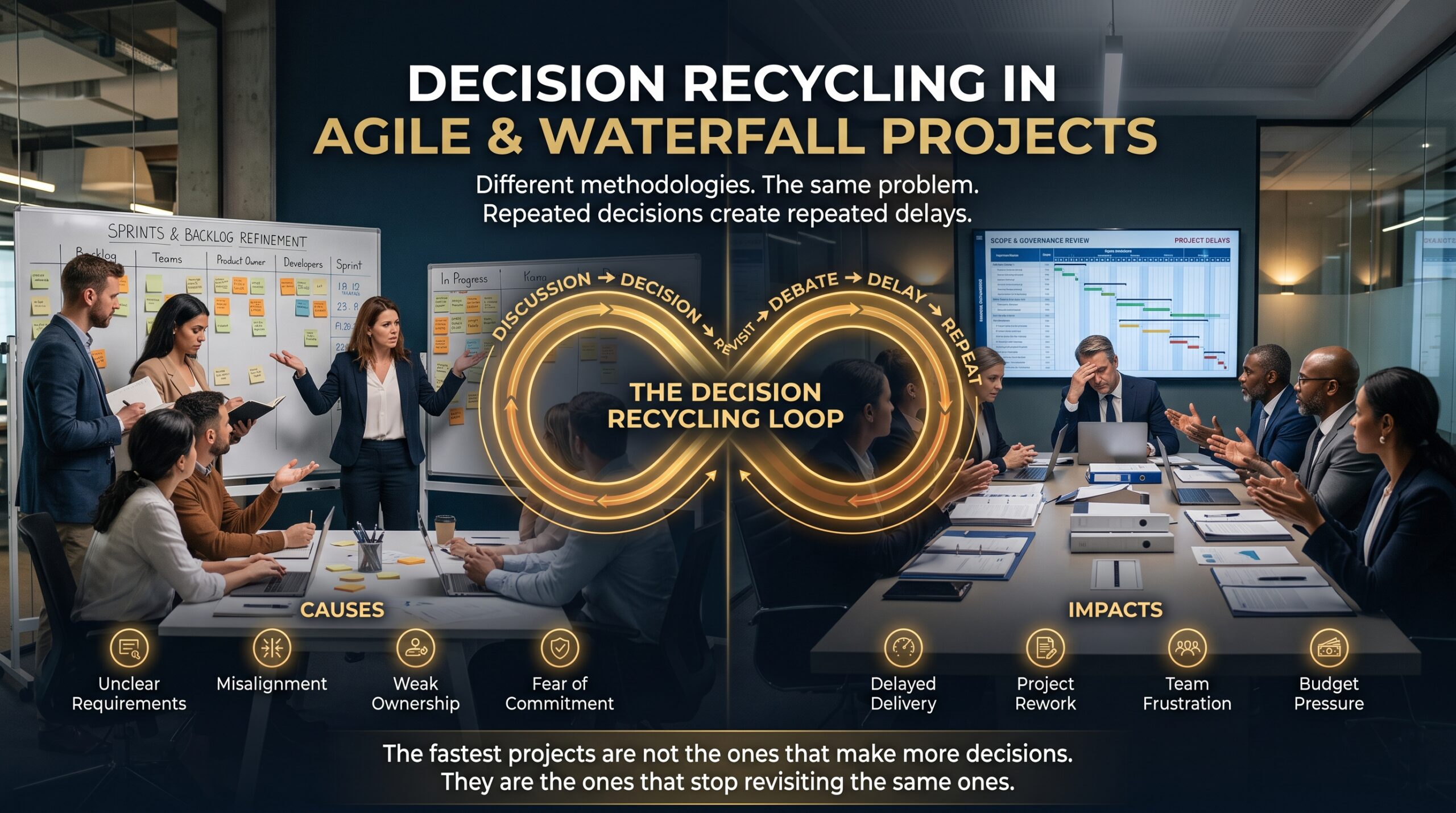
Decision recycling is what happens when a team makes a call on Monday and finds itself debating the very same call on Thursday. Nobody changed their mind because of new evidence. Someone simply wasn’t in the room, or didn’t quite agree, or can’t remember what was said. So the item lands back on the agenda, the same people repeat the same arguments, and everyone leaves with the sinking feeling that they’ve had this conversation before.
It’s so common that most of us have stopped noticing it. Yet it quietly drains time, budget and goodwill from projects of every size. A well-known McKinsey Global Survey from 2017 found that only 20 per cent of respondents said their organisations excel at decision making, and that on average 61 per cent said most of their decision-making time was used ineffectively. In this guide we’ll look at what causes decision recycling, how to spot it, and the practical steps project managers use to break the loop.
What Is the Decision Recycling Effect?
The decision recycling effect is the pattern of making, forgetting, reopening and remaking the same decisions over and over. It’s different from healthy review. Revisiting a decision because circumstances changed is good governance. Reopening it because nobody wrote it down, or because the loudest voice never accepted it, is waste.
You’ll see it in boardrooms, steering committees, sprint planning sessions and Friday catch-ups alike. Picture a steering committee that approves a vendor in March, hears fresh objections in April, “pauses” the choice in May and ends up reviewing the same shortlist in June. Four months, one decision, zero progress.
For project teams the effect is especially costly, because projects run on momentum. Every reopened decision resets the clock for the people waiting to act on it.
Signs Your Team Is Stuck in Decision Recycling
Here are the warning signs worth watching for:
- The same item keeps returning. It appears agenda after agenda, usually labelled “for discussion” or “revisit”.
- People say “I thought we’d agreed.” Different people left the same meeting with different understandings.
- Nobody can find the decision. It lives in someone’s memory, a long email chain or a chat thread that scrolled away.
- Approved work gets reopened. Stakeholders raise objections after sign-off, when changing course is most expensive.
- Meetings end without an owner or a date. There’s plenty of discussion, but no one is named to decide or act.
- New joiners restart old debates. The reasoning was never recorded, so a staff change reopens the argument.
If three or more of these sound familiar, decision recycling is probably costing you more than you think.
Why Decision Recycling Happens
There’s rarely a single cause. Most cases trace back to a handful of structural gaps:
- No clear decision owner. When everyone has a say and nobody has the final say, every decision stays soft.
- No record. Without a decision log, a decision is just a memory, and memories differ.
- Missing stakeholders. Someone affected wasn’t consulted, so they reopen the issue later, often with fair reason.
- A consensus culture. Waiting until everyone is comfortable means a decision is never really final.
- Unclear reopening rules. Without defined triggers, teams can’t tell “new information” from “second thoughts”.
- Staff turnover and lost context. The people who made the decision move on, and the reasoning goes with them.
- Fear of accountability. Deferring feels safer than owning a call that might go wrong.
Notice that none of these are about intelligence or effort. They’re about structure. That’s good news, because structure can be fixed.
The Hidden Cost of Decision Recycling
The cost rarely shows up as a line item, which is exactly why it survives. But the hours add up. The McKinsey survey found that just over half of respondents spent more than 30 per cent of their working time on decision making, and 61 per cent said most of that time was used ineffectively. These are self-reported figures from a global sample rather than a precise measure of recycling, yet they point in the same direction: a lot of decision time goes to waste.
In project terms, the damage tends to appear in five places:
- Schedule slippage. Work waits while the decision is reopened.
- Scope creep. Old arguments return disguised as “small changes”.
- Budget pressure. Rework after a reversal usually costs more than the original choice.
- Team frustration. People who delivered on a decision get told to stop.
- Stakeholder fatigue. Trust erodes when nothing ever seems final.
It’s no coincidence that the Project Management Institute and the Australian Institute of Project Management both treat governance and clear accountability as core to good project delivery.
How to Stop Decision Recycling: A Seven-Step Fix
- Name one decision owner. Use a simple model like RACI or Bain’s RAPID framework, which separates who recommends, who gives input, who must agree and who decides. One person decides. Everyone else knows their role.
- Write every decision down. Keep a decision log with the decision, the date, the owner and who was present. Two lines are better than none.
- Record the why. Note the options considered and the reasoning. When someone asks “why did we choose this?” six months later, the answer exists.
- Set reopening triggers. Agree up front what would justify revisiting the decision: a budget change above a set threshold, a risk that materialises, a regulatory update. No trigger, no reopening.
- Sort decisions by reversibility. Some calls are easy to undo and some aren’t. Spend your debating time on the hard-to-reverse ones and decide the easy-to-reverse ones quickly.
- Time-box and escalate. If a decision isn’t made by the deadline, it moves up a level automatically instead of drifting back onto the agenda.
- Close the loop. Circulate decisions in writing within a day, and open the next meeting by reading the recent ones aloud. People can disagree in the room and still back the outcome.
Decision Recycling in Agile and Waterfall Projects
Both approaches have built-in tools for this problem. They only work if people actually use them.
In PRINCE2, decision authority is spelled out through the project board, stage boundaries, tolerances and exception reporting, while logs such as the daily log and issue register capture what was decided. The PRINCE2 Foundation course covers these governance basics, and the PRINCE2 Practitioner course teaches you to apply them on a live project.
Agile teams have their own versions. A product owner makes prioritisation calls, a definition of done settles what “finished” means, and retrospectives give the team a scheduled place to raise concerns instead of reopening work mid-sprint. The AgilePM Foundation and PRINCE2 Agile Foundation courses show how to blend agile delivery with clear governance, which is exactly where decision recycling tends to creep in.
For larger programs, PMP certification and structured project planning and control training add depth on stakeholder management, change control and reporting. IT teams may prefer CompTIA Project+, which is built around technology projects.
Decision Recycling Across Australian Cities
Decision recycling isn’t a Melbourne problem or a Sydney problem. It turns up wherever groups of people deliver work together: construction and infrastructure projects in Melbourne, technology and finance programs in Sydney, resources and engineering work in Brisbane and Perth, departments and agencies in Canberra, health and education projects in Adelaide, and community and government work in Hobart and Darwin.
If you want to build the skills to fix it, you can explore project management training in Melbourne, Sydney, Brisbane, Perth, Canberra and Adelaide. Live online options also serve professionals in Hobart and Darwin, so location doesn’t have to be a barrier.
Project Management Training That Builds Decision Discipline
Tools only help when people know how to use them. A good project management course turns decision governance from theory into habit. The project management certifications at projectmanagementcertifications.com.au are built around structured courses, hands-on practice, mock tests and dedicated support, with flexible online and instructor-led delivery. You can choose a path by experience level:
- Foundational: PRINCE2 Foundation, AgilePM Foundation and CompTIA Project+ for newcomers, coordinators and team leaders.
- Intermediate: PRINCE2 Practitioner and AgilePM Practitioner for people already running projects.
- Advanced: PMP certification and project planning and control for senior roles and larger programs.
Not sure which suits you? Check the FAQs, browse more ideas on the project management blog, or contact the team on 1300 649 299. You can also enquire about group training for a whole project team, which is one of the fastest ways to give everyone the same decision-making language.
Frequently Asked Questions About Decision Recycling
What is decision recycling?
Decision recycling is when an organisation repeatedly reopens and re-debates decisions that were already made, usually because the decision wasn’t clearly owned, recorded or communicated.
Why do organisations keep having the same meetings?
Usually because meetings end with discussion rather than decisions. Without a named owner, a written record and a deadline, the topic has nowhere to go except back onto the next agenda.
How do you stop teams from reopening decisions?
Assign one decision owner, log every decision with its reasoning, and agree in advance what would justify reopening it. Then circulate the outcome in writing so everyone starts from the same version of events.
What is a decision log?
A decision log is a simple record of what was decided, when, by whom and why, plus any conditions for revisiting it. A shared spreadsheet or a page in your project tool is enough to start.
Which project management course helps with decision-making and governance?
PRINCE2 is strong on governance and decision authority, AgilePM suits teams that deliver iteratively, and PMP covers stakeholder, risk and change management in depth. Compare the options on the certifications page or ask the team which fits your role.
Final Thoughts: Make Decisions That Stay Made
Repeating conversations feel productive because everyone is busy talking. But a decision that has to be made three times was never really made at all. The organisations that move fastest aren’t the ones with the cleverest people in the room. They’re the ones that know who decides, write it down and respect the outcome.
Start small. Pick the one topic your team keeps revisiting, name an owner, log the outcome and set a reopening trigger. Then, if you’d like to build these habits into your career, explore the project management courses available across Australia and take the next step