


The certification application gap is the distance between what a project manager knows from certification training and what they can actually do when a real project gets messy. They passed the exam. They can recite the processes. Then the sponsor changes the brief, the supplier misses a delivery and two stakeholders want opposite things, and the neat framework from the classroom suddenly feels very far away.
If you manage projects in Sydney, Melbourne, Brisbane, Perth, Adelaide or Canberra, you have likely felt this, or watched a talented colleague feel it. It is not a sign that certification is worthless. It is a sign that knowing a framework and applying it under pressure are two different skills. This guide explains the certification application gap, why it happens, and how to close it.
| Quick answer: Certified project managers struggle on real projects because exams reward knowledge of frameworks in clean scenarios, while real projects involve ambiguity, politics, incomplete information and competing priorities. Closing the gap means practising tailoring, decision-making and stakeholder conversations on live work, supported by feedback. |
What Is the Certification Application Gap?
Certifications such as PRINCE2, PMP and AgilePM give project managers a shared language and a tested structure. They explain how to plan, control risk, manage stages and govern change. That foundation is valuable, and employers rightly look for it.
The certification application gap appears in the translation step. A course scenario has clear facts, cooperative people and a single correct answer. A real project has missing facts, tired people and several defensible answers. Moving from one to the other takes judgement, and judgement only grows through practice and reflection.
Here is a simple example. A newly certified manager knows that a risk register should be kept up to date. On a live project, though, risks are uncomfortable to name, owners are reluctant to accept them and the register becomes a list nobody reviews. The knowledge was correct. The application, which involves tact, persistence and timing, was missing. That is the certification application gap at work.
Seeing the gap clearly is the first step to closing it. Certification is the starting point of professional capability, not the finish line.
Exam Project vs Real Project: Where the Certification Application Gap Opens
| Dimension | Exam or Course Scenario | Real Project |
| Information | Complete and consistent | Partial, late or contradictory |
| Stakeholders | Cooperative and predictable | Busy, political and changeable |
| Scope | Defined at the start | Evolves as the work is understood |
| Authority | Project manager has clear decision rights | Decision rights are blurry or shared |
| Method | One framework applied as taught | Hybrid of agile delivery and formal governance |
| Feedback | Instant through marks | Slow, indirect and often political |
| Right answer | One best option | Several trade-offs, none perfect |
Why Qualified Project Managers Still Struggle on Real Projects: 7 Causes
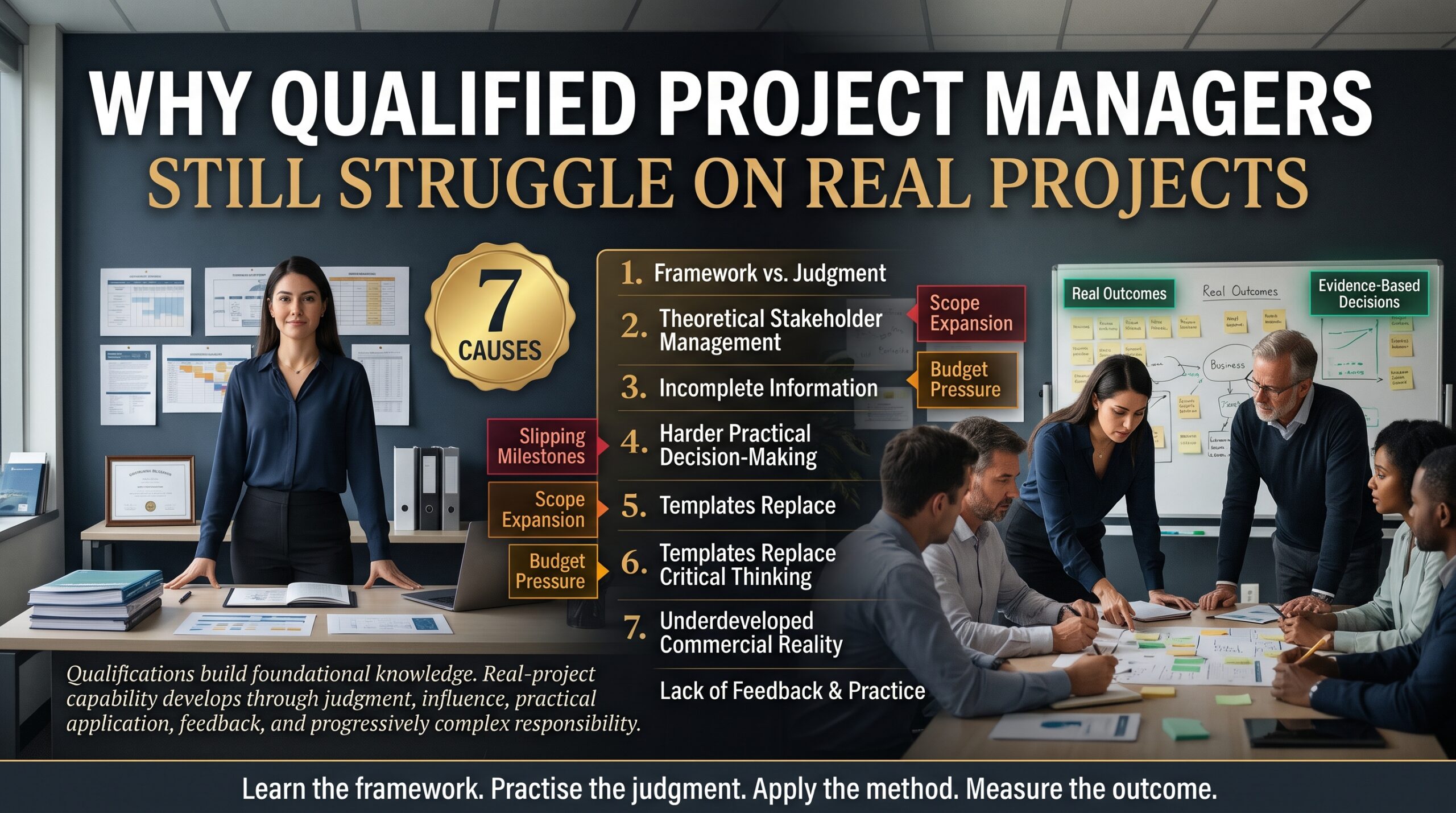
1. Frameworks assume more clarity than projects have
Planning tools work best when inputs are known. In reality, requirements shift, estimates are guesses and dependencies are discovered halfway through. Project managers who wait for certainty before acting find that certainty never arrives.
2. Tailoring is rarely practised
Good frameworks expect adaptation. PRINCE2 explicitly encourages tailoring to suit the project, and the PMBOK Guide takes a similar approach. Yet many new practitioners apply every template to every project, which creates heavy paperwork on small work and thin control on large work.
3. People and politics are not in the answer key
Sponsors have agendas, teams have history and stakeholders have competing priorities. Exams touch on stakeholder engagement, but navigating a difficult conversation with a senior executive is learned by doing it.
4. Responsibility without authority
Project managers are often accountable for outcomes without control over budgets, people or priorities. The framework says who should decide; the organisation may never have agreed. Without clear decision rights, even a well-run project stalls.
5. Information arrives late, incomplete or wrong
Status reports are optimistic, risk registers go stale and the real problems sit in hallway conversations. Spotting weak signals early is a skill that grows with experience and good relationships.
6. Hybrid delivery blurs the rules
Many Australian organisations run agile teams inside waterfall governance. A project manager trained in one approach may struggle to bridge the two, especially when funding, reporting and delivery speeds do not match.
7. There is no feedback loop
After the exam, nobody marks your decisions. Without a mentor, peer review or regular reflection, project managers repeat the same patterns and never see why. A stalled certification application gap is often a feedback gap in disguise.
8 Warning Signs of a Certification Application Gap
- You can explain the framework but feel unsure how to use it on Monday morning.
- You produce many documents that nobody reads or acts on.
- Risks are logged but rarely change decisions.
- You avoid difficult conversations with sponsors or senior stakeholders.
- Your projects feel reactive, with constant firefighting.
- You are unsure which parts of the method to drop or adapt.
- Teams see you as an administrator rather than a leader.
- Lessons learned are written at the end but never applied.
If several of these sound familiar, you are experiencing the certification application gap. The good news is that it responds well to deliberate practice.
What Experienced Project Managers Do Differently
Seasoned project managers are not smarter than newly certified ones. They have simply run enough projects to recognise patterns. They tailor without fuss, because they know which controls matter for this kind of risk. They raise bad news early, because they have seen what happens when it surfaces late. They build relationships before they need them, and they ask sponsors for decisions instead of waiting for permission. Most importantly, they reflect. After each phase they ask what worked, what did not and what they would change.
The encouraging part is that these habits can be learned deliberately. You do not need ten years to start behaving like an experienced project manager. You need a conscious routine for reflection and a willingness to try, adjust and try again.
The Cost of an Unclosed Certification Application Gap
For the project manager, the cost is stress, slow growth and a nagging sense of being an imposter despite the qualification. For the team, it is unclear direction and avoidable rework. For the employer, it is delayed delivery, budget overruns and a weaker return on certification spend. Left alone, the certification application gap can also hold back careers, because people who struggle to apply their skills tend to be given smaller, safer projects.
The Certification Application Gap in Practice: Scenarios From Australian Cities
These composite scenarios are based on common patterns, not individual cases.
Sydney: A PRINCE2-qualified manager on a banking programme produces every governance document in the template, but the delivery team ignores most of them. Sydney project managers in large programmes often need to scale governance to fit the work.
Melbourne: A PMP-certified manager on an infrastructure project meets scope and schedule goals on paper but struggles when subcontractors dispute responsibilities. Melbourne teams often find contract negotiation matters more than the plan.
Brisbane: A project manager inherits a hybrid programme with agile delivery teams and fixed-gate funding. The framework offers no single script. Brisbane organisations moving to hybrid delivery see this tension daily.
Perth: A resources project depends on remote sites and long procurement lead times. Textbook schedules fall apart without local knowledge. For Perth managers, logistics judgement is part of the job.
Adelaide: A manufacturing upgrade has an eager sponsor and an unclear scope. The manager keeps asking for clarity instead of proposing options. In Adelaide, leading with a recommendation often moves things faster.
Canberra: A government project shifts direction after a priority change. The manager has the right plan for the old brief. Canberra project teams learn to build change into their planning.
How to Close the Certification Application Gap in 8 Steps
- Turn every concept into a live artefact. Build a real risk register, stakeholder register or business case on your current project instead of leaving them as exam topics.
- Tailor on purpose. Write a one-page note explaining which parts of the method you will use, adapt or skip, and why.
- Practise deciding with incomplete information. Keep a decision log with the options, your reasoning and what happened. Review it monthly.
- Map stakeholders and talk early. Identify who can influence the project, and have difficult conversations before they become urgent.
- Clarify decision rights at the start. Agree with the sponsor who decides what, so authority matches accountability.
- Run lightweight lessons learned throughout. A short review every few weeks beats a long report at the end.
- Find feedback. Seek a mentor, a peer review partner or a professional community such as AIPM or PMI.
- Layer certifications with experience. Move from foundation to practitioner to advanced credentials as you apply each level on real work.
Which Certification Helps Close Which Gap?
Different certifications support different parts of the journey. Choose the one that fits the gap you actually feel.
| Where You Struggle | Helpful Certification Path |
| Understanding project structure and governance basics | PRINCE2 Project Management Foundation |
| Applying and tailoring PRINCE2 on live projects | PRINCE2 Project Management Practitioner |
| Working in agile or hybrid environments | PRINCE2 Agile Foundation and PRINCE2 Agile Practitioner |
| Delivering iteratively with governance | AgilePM Foundation and AgilePM Practitioner |
| Scheduling, estimating and controlling work | Project Planning and Control |
| Starting out in IT or information systems projects | CompTIA Project+ or BCS IS Project Management Foundation |
| Senior leadership across complex projects | Project Management Professional (PMP) |
For AgilePM, the Agile Business Consortium is the custodian of the approach. You can compare every pathway on our certifications page.
A Simple Decision Log Example
A decision log is one of the easiest tools for closing the certification application gap. It turns every judgement call into a learning opportunity. A basic version only needs four columns:
| Decision | Options Considered | Reason Chosen | What Happened |
| Delay go-live by two weeks | Go live on time, delay, phase the launch | Testing risks outweighed the date | Fewer incidents, sponsor satisfied |
| Drop a weekly report | Keep, shorten, replace with a dashboard | Nobody used the full report | Time saved, team more focused |
How Employers Can Help Close the Certification Application Gap
Organisations that pay for certification should also pay attention to what happens afterwards. The most effective employers pair newly certified staff with an experienced mentor, give them a stretch project with appropriate support and set aside time for review. They also make decision rights clear, so project managers are not asked to deliver outcomes without the authority to act. These small investments protect the value of the training spend and shorten the time it takes for a certification to show up as better delivery.
A Quick Checklist Before Your Next Project Starts
- Have you tailored the method to the size and risk of this project?
- Do you and the sponsor agree who makes which decisions?
- Is there a simple way to capture decisions and assumptions?
- Do you know your top five stakeholders and what each one cares about?
- Is someone available to give you honest feedback during the project?
- Have you planned short reviews along the way, not only at the end?
Study Project Management in Sydney, Melbourne, Brisbane, Perth, Adelaide and Canberra
Our certification training is available for professionals in Sydney, Melbourne, Brisbane, Perth, Adelaide and Canberra, as well as online and through in-house options. See the full picture on our locations page.
Frequently Asked Questions About the Certification Application Gap
What is the certification application gap?
It is the difference between the project management knowledge gained through certification and the ability to apply it effectively on real, messy projects.
Why do certified project managers still struggle?
Because exams test knowledge in clean scenarios, while real projects add ambiguity, politics, hybrid delivery and incomplete information that call for judgement built through experience.
Is project management certification still worth it?
Yes. It provides a common language and structure that employers value. It works best when paired with deliberate practice and feedback on real projects.
How long does it take to close the gap?
There is no fixed timeline, but most people see clear progress within a few projects when they tailor deliberately, keep a decision log and seek regular feedback.
Should I choose PRINCE2, PMP or AgilePM to close the gap?
Choose the one that matches the way your organisation delivers work. PRINCE2 suits structured governance, AgilePM suits iterative delivery with control, and PMP suits broader leadership across varied environments.
How do I get experience if I am new to project management?
Volunteer for small internal projects, shadow an experienced manager, run a piece of work end to end and keep a decision log. Practical exposure matters as much as the credential.
Can employers help close the certification application gap?
Yes. Mentoring, clear decision rights, project reviews and time to reflect all help certified staff turn knowledge into reliable performance.
Final Thoughts: Turn Knowledge Into Capability
The certification application gap is normal, and it is fixable. Treat your qualification as the foundation, then build capability through live practice, honest feedback and deliberate tailoring. If you are ready to take the next step, contact our team or explore our project management certifications.