


Project priority conflict is what happens when every project on the list is marked “critical” and the same small group of people is expected to deliver all of them at once. If you’ve ever sat in a meeting where three urgent initiatives were fighting over one developer, one analyst or one budget line, you already know how it feels. Everyone is busy, nothing finishes on time and the people doing the work quietly wonder how any of it is supposed to succeed.
This guide explains why project priority conflict happens, what it costs, how to spot it early and, most importantly, how to fix it. Whether you’re a project manager, a team leader, a PMO analyst or an executive who signs off the portfolio, you’ll find practical steps you can use this quarter.
What Is Project Priority Conflict?
At its simplest, project priority conflict is a situation where multiple projects compete for the same limited resources, such as people, budget, time and management attention, and leaders refuse or fail to rank them. When everything is a top priority, nothing really is. Teams are left to guess which work matters most, and they usually guess based on who shouted loudest last.
It’s not a sign of a weak team. It’s a sign of a weak decision process. The conflict lives above the project level, in how organisations choose, fund and sequence work. That’s why even highly skilled project managers can’t fix it alone, but they can expose it and push for better decisions.
Why Every Project Becomes “Critical”
Nobody sets out to create chaos. Project priority conflict usually grows from understandable pressures:
- Competing executives. Each leader is accountable for their own targets, so each defends their own projects as essential.
- No shared scoring method. Without agreed criteria, priority becomes a matter of politics and persuasion rather than evidence.
- Fear of saying no. Pausing or cancelling a project feels like failure, so work piles up and nothing is ever removed.
- Hidden capacity limits. Leaders see a list of projects but not the real availability of the people who must deliver them.
- Regulatory and customer deadlines. Genuine external pressures make some work feel non-negotiable, even when it isn’t all equally urgent.
- Constant change. New opportunities and urgent requests arrive weekly, and they’re added to the pile rather than traded off against it.
The Real Cost of Project Priority Conflict
The damage rarely shows up on a single report, which is why project priority conflict persists for so long. It leaks out in many small ways.
Constant Multitasking and Context Switching
When people are split across five projects, they spend a large share of their day switching between them. Each switch costs focus and time, so total output actually falls even though everyone is working harder.
Delays Across the Whole Portfolio
Spreading resources thinly means every project advances slowly. Instead of finishing two projects well, the organisation has six projects that are all “nearly done” and none delivering value.
Lower Quality and More Rework
Rushed work and fragmented attention lead to mistakes. Fixing those mistakes later consumes the very capacity that was missing in the first place.
Burnout and Staff Turnover
Your best people are usually the ones everybody asks for. Overloaded, they burn out or leave, taking critical knowledge with them and making the next project even harder.
Eroded Stakeholder Trust
When deadlines slip repeatedly, sponsors and customers lose confidence. Project managers end up spending their time explaining delays rather than preventing them.
Warning Signs of Project Priority Conflict
You don’t need a formal audit to see it coming. Watch for these signals:
- Team members regularly ask, “Which of these should I work on first?” and receive different answers from different managers.
- Project status reports are consistently amber or red, and the explanation is always resource shortages.
- Escalations arrive daily, and each one is described as urgent.
- Projects start before earlier ones finish, and the backlog keeps growing.
- Nobody can name the top three organisational priorities with confidence.
How Project Priority Conflict Plays Out Across Australian Cities
The pattern is common nationwide, though the flavour changes by location. In Melbourne, organisations in construction, technology, healthcare, finance and government often run overlapping programs that draw on the same pool of specialists. In Sydney, dense financial and professional services environments can generate a constant stream of urgent change requests. Brisbane is seeing large infrastructure and services growth that stretches delivery teams, while Canberra agencies juggle policy deadlines, security requirements and shifting government priorities. In Perth and Adelaide, project teams often work across resources, engineering and public-sector initiatives where a few key people carry enormous load.
Whatever the city or industry, the underlying fix is the same: make priorities explicit, match work to real capacity and govern the portfolio with discipline.
Proven Methods to Resolve Project Priority Conflict
There’s no single perfect formula, but several well-established approaches help organisations rank work fairly. You can use one or combine them.
Weighted Scoring Against Strategy
Agree a short list of criteria, such as strategic alignment, financial return, risk reduction, regulatory necessity and customer impact. Score each project against them and rank the results. The numbers don’t replace judgement, but they make debates evidence-based.
MoSCoW Prioritisation
Used widely in agile delivery, MoSCoW sorts work into Must have, Should have, Could have and Won’t have this time. It forces the uncomfortable but necessary conversation about what is genuinely essential versus merely desirable, and it works at the project level as well as the portfolio level.
Cost of Delay
Ask what each week of delay actually costs in lost revenue, increased risk or missed opportunity. Projects with a high cost of delay should be done first. This reframes the conversation from opinions to economics.
Capacity-Based Planning
List every active project, then compare total demand against the real availability of the teams delivering it. If demand exceeds capacity, something has to wait. Capacity planning turns “we need everything” into “we can do these three now”.
Stage Gates and Exception Management
Frameworks such as PRINCE2 build in continued business justification, delivery by stages and management by exception. That structure gives sponsors regular points to ask whether a project still deserves its place in the queue, and gives project managers a clear way to escalate when tolerances are threatened.
A Step-by-Step Plan to Reduce Project Priority Conflict

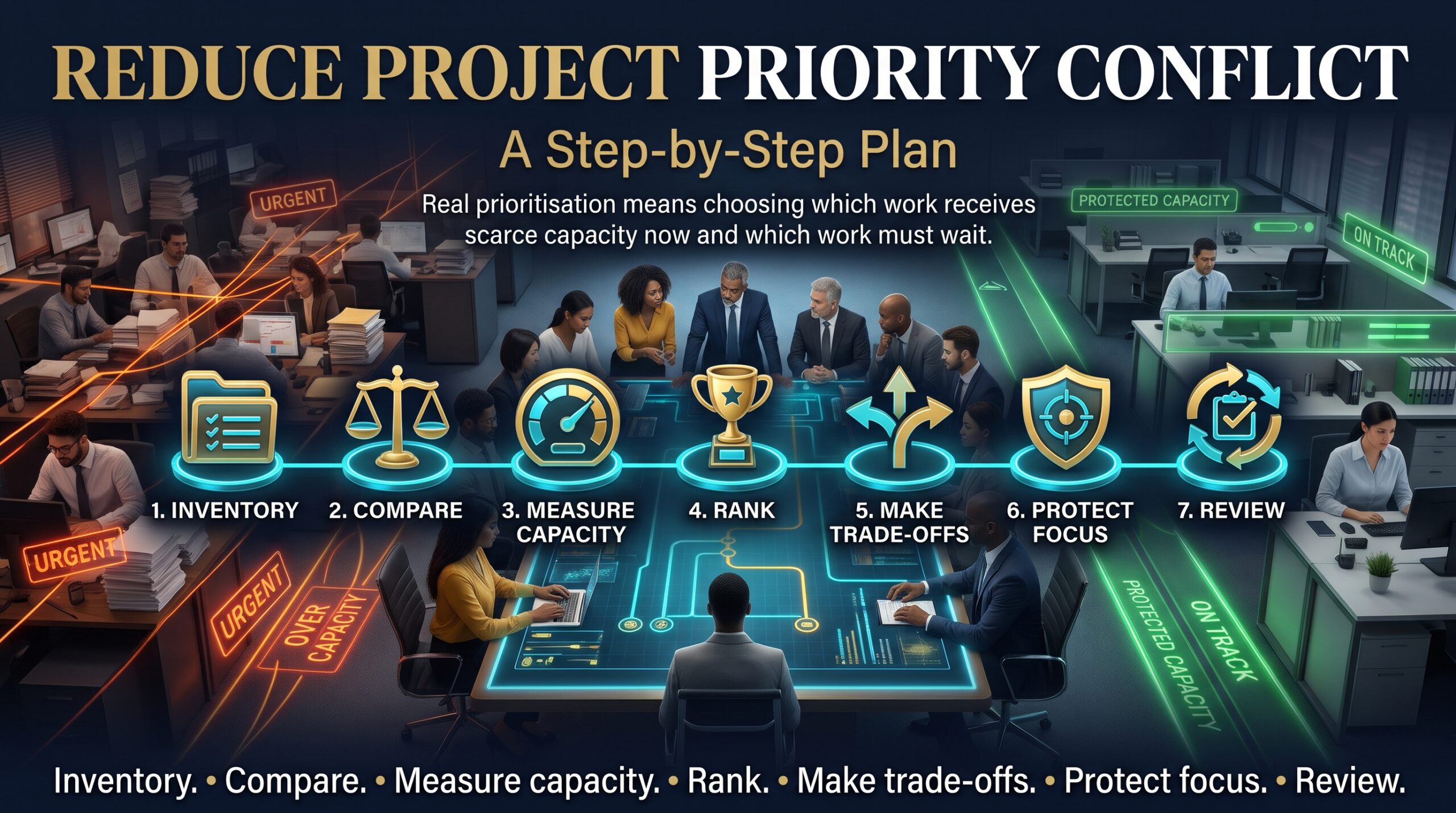
- Make a single list. Capture every active and proposed project in one visible register, with owners, sponsors and resource needs.
- Agree the criteria. Get executives to sign off how priority will be decided before they see the rankings.
- Score and rank. Apply the criteria consistently and publish the results so everyone can see the logic.
- Limit work in progress. Set a cap on how many projects can run at once, based on real capacity.
- Protect your people. Assign people to fewer projects at a time, and avoid splitting key specialists across many initiatives.
- Create a trade-off rule. If a new project is urgent, something of equal size must be paused or removed.
- Review on a rhythm. Revisit priorities monthly or quarterly so they reflect reality instead of last year’s plan.
- Communicate decisions. Tell teams what is in, what is waiting and why, so people stop guessing.
The Project Manager’s Role in Project Priority Conflict
Project managers sit at the sharp end of this problem, and the best ones act as translators between strategy and delivery. They bring data about capacity, risk and dependencies to leadership, and they ask better questions. A few that work well:
- “If this is critical, which current project should we pause to make room for it?”
- “What is the cost of delaying this by a month, compared with the other options?”
- “Who has the authority to decide if two sponsors disagree?”
- “What happens to quality and risk if we proceed with the current resourcing?”
Asking calmly and with evidence is far more effective than complaining. It moves the conversation from frustration to decision-making.
Where to Find Guidance and Standards
If you want to go deeper, several professional bodies publish helpful material. The Project Management Institute offers research and standards on portfolio and project delivery. The Australian Institute of Project Management supports local practitioners with resources and networking. The Agile Business Consortium provides guidance on agile approaches including prioritisation, and Jobs and Skills Australia shares insight into occupations and skills demand across the country.
Certifications That Help You Tackle Project Priority Conflict
Understanding frameworks gives you the vocabulary and the credibility to push back when priorities are muddled. Certification training also teaches proven techniques for planning, governance, risk and stakeholder management, exactly the tools needed to manage project priority conflict. Here are pathways worth exploring on our project management certifications page:
- PRINCE2 Project Management Foundation and PRINCE2 Project Management Practitioner for structured, stage-based control and governance.
- PRINCE2 Agile Foundation and PRINCE2 Agile Practitioner for blending structure with agile flexibility.
- AgilePM Foundation and AgilePM Practitioner for agile delivery with built-in prioritisation and timeboxing.
- BCS IS Project Management Foundation for information systems project fundamentals.
- CompTIA Project+ for practical project skills, especially in technology settings.
- Project Planning & Control for scheduling, tracking and managing delivery performance.
- Project Management Professional (PMP) for advanced, globally recognised project leadership.
Training is available through flexible online learning and instructor-led classes for professionals in Sydney, Melbourne, Brisbane, Perth, Adelaide and Canberra, with more on the locations page. Weekday, weeknight and weekend options help you study around work.
Project Priority Conflict FAQs
What causes project priority conflict?
It’s usually caused by too many projects, limited resources and no agreed way to rank work. Competing executives, fear of saying no and poor visibility of capacity make it worse.
How do you prioritise projects when everything is urgent?
Use shared criteria such as strategic alignment, cost of delay, risk and capacity. Score projects consistently, publish the ranking and agree a rule for trade-offs when new requests arrive.
Who is responsible for resolving project priority conflict?
Ultimately senior leaders and the project sponsor group, often supported by a PMO. Project managers play a vital role by surfacing data and escalating clearly, but they can’t set organisational priorities alone.
Can certification help with project priority conflict?
Yes. Frameworks like PRINCE2, AgilePM and PMP teach governance, prioritisation and escalation techniques that help you handle competing demands professionally. Our FAQs page answers common questions about courses and exams.
Final Thoughts: Choose What Matters, Then Deliver It
Project priority conflict isn’t solved by working harder or adding more projects to the list. It’s solved by choosing. When organisations agree what matters most, protect their people and review decisions regularly, delivery gets faster, quality improves and teams feel the difference.
If you’d like to build the skills to lead that change, explore our project management courses, read more on the blog, learn about us, or contact the team on 1300 649 299 to find the right certification pathway.