


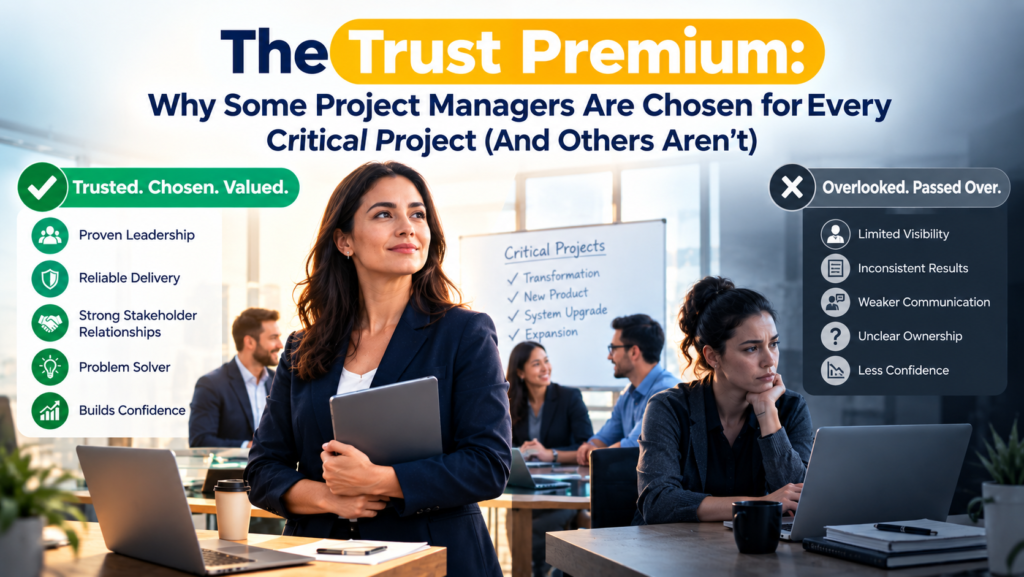

Project manager career paths look almost identical for the first five years. Same certifications, same stand-ups, same status reports, same late-night scramble before a go-live. Then something odd happens. One person gets tapped for a director role, a seat at the leadership table and eventually a C-suite title. Another, just as hardworking and just as skilled, keeps getting handed the next big project and never moves beyond it.
It is tempting to blame politics or luck, and sometimes those do play a part. But in most cases the gap comes down to a handful of choices about how people think, what they learn and where they spend their time. In this guide, we will break down those choices, show how a project manager career can grow into senior leadership, and give you a practical plan you can start using this month, whether you work in Melbourne, Sydney, Brisbane, Perth or elsewhere in Australia.
The Project Manager Career Path: Where Most People Plateau
The classic project manager career path moves from project coordinator to project manager, then senior project manager, program manager and head of a project management office (PMO). From there, some people step into director, general manager or executive roles such as COO or CIO. On paper it looks like a ladder. In reality, most people stall around the senior project manager stage.
The reason is simple. Up to that point, you are rewarded for delivering well. Past that point, you are rewarded for deciding well, for choosing which work is worth doing, who should do it and how it supports the business. Many people keep getting better at the first skill and never practise the second.
Delivery Manager or Business Leader? The Real Difference
Project managers who stay in delivery roles tend to ask, “How do we get this done on time and on budget?” Executives ask a bigger question: “Should we be doing this at all, and what will it mean for the organisation?” Both questions matter, but only the second one gets you into the boardroom. That shift in thinking is the heart of any project manager career that reaches the top.
| Stays a Project Manager | Becomes an Executive | |
| Main question | How do we deliver this? | Why are we doing this, and is it worth it? |
| Success measure | On time, on budget, on scope | Business value, growth and risk reduction |
| Relationships | Team and project sponsor | Sponsors, executives, board and customers |
| Language | Schedules, tasks and deliverables | Strategy, revenue, cost and outcomes |
| Time horizon | Current project | Portfolio, next year and beyond |
7 Things Project Managers Who Become Executives Do Differently
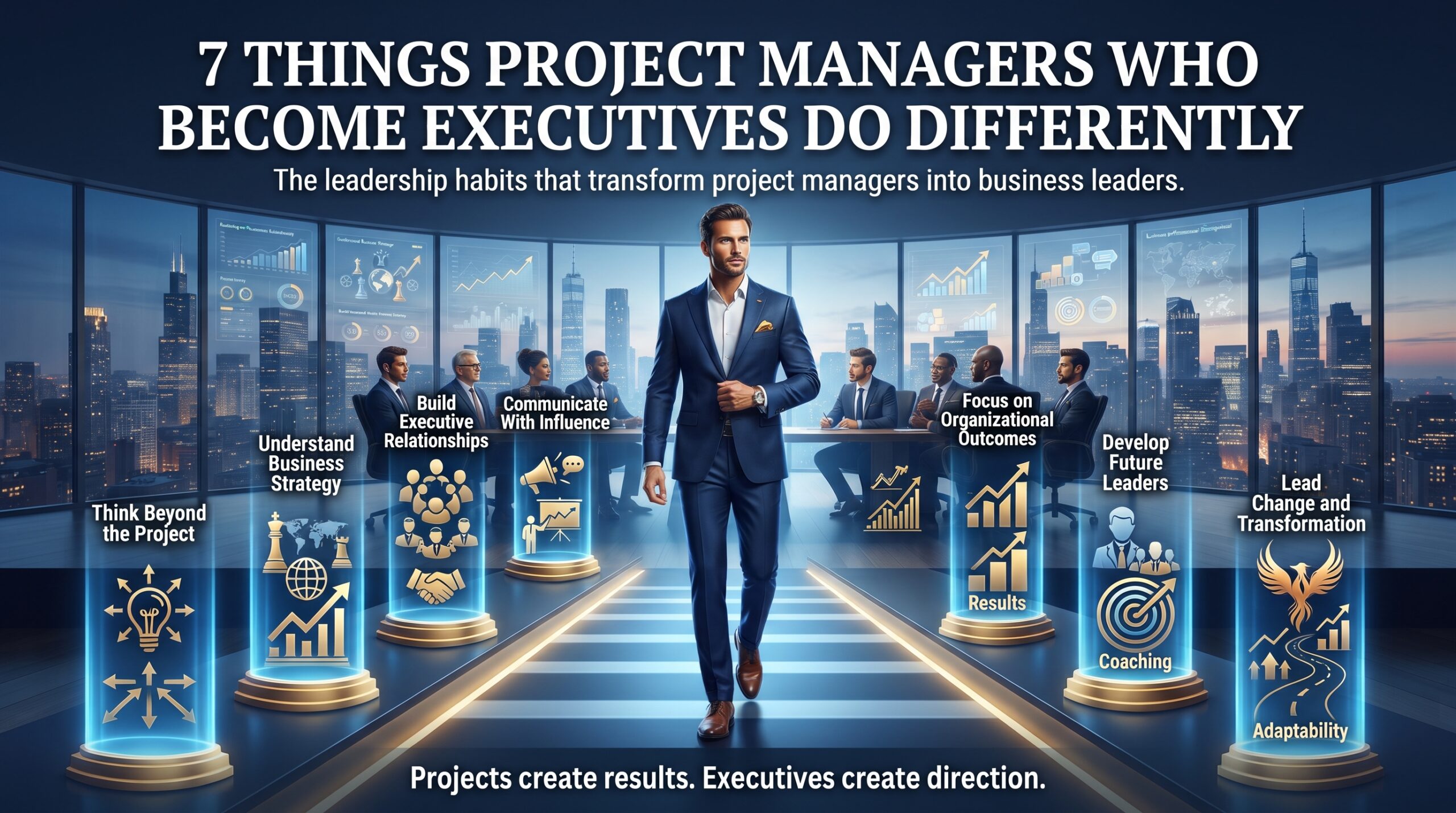
Here are seven habits that separate a stalled project manager career from one that keeps rising.
1. They focus on outcomes, not just outputs
A project can finish perfectly and still fail the business if nobody uses what was built. Future executives keep asking what changed because of their work: more revenue, lower costs, happier customers, reduced risk. They talk about benefits and results, not only milestones.
2. They learn to speak the language of money
Executives think in budgets, margins, business cases and return on investment. Project managers who want to progress learn to read a profit and loss statement, build a business case and explain trade-offs in financial terms. If you can say “this delay costs us this much each month,” people listen.
3. They manage up as well as down
Great delivery managers look after their teams. Future executives also build real relationships with sponsors and senior stakeholders. They give short, honest updates, flag risks early and make the people above them look good. Trust at the top is the fastest route to bigger responsibilities.
4. They move from projects to programs and portfolios
One project is a single bet. A program or portfolio is a set of bets that must work together. People who step up learn to manage dependencies, balance competing priorities and decide where limited money and people should go. That is exactly what executives do all day.
5. They lead through influence, not authority
Most project managers lead people who do not report to them. That is excellent training. The ones who become executives sharpen it by negotiating, coaching, resolving conflict and persuading without relying on a title.
6. They take on messy, strategic problems
Some people only volunteer for clean, well-defined projects. Future leaders raise their hand for the awkward ones: a failing program, a merger, a transformation nobody wants. Solving visible, difficult problems is how reputations get made.
7. They invest in learning at the right moments
Certifications will not make you an executive by themselves, but they can open doors and signal credibility, especially early on. Smart professionals choose credentials that match their next step instead of collecting them randomly. We cover the main options below.
Project Manager Career Stages: From Coordinator to Executive
| Stage | Typical role | What to build next |
| Entry | Project Coordinator or Officer | Core methods, scheduling, reporting, a foundation certification |
| Early | Project Manager | Budgeting, risk management, stakeholder skills, a practitioner certification |
| Mid | Senior Project Manager | Complex delivery, mentoring, commercial awareness |
| Senior | Program Manager or PMO Lead | Portfolio thinking, governance, benefits realisation |
| Executive | Director, General Manager, COO or CIO | Strategy, financial leadership, executive presence |
Not every project manager career needs to end in the C-suite, and that is perfectly fine. A project manager career can be rewarding at every level. Plenty of people love senior delivery work or specialist roles. The point is to choose deliberately rather than drift.
Certifications That Support a Project Manager Career
Credentials are most useful when they match where you are in your project manager career. Professional bodies such as the Project Management Institute and the Australian Institute of Project Management both publish career resources, and you can read more about the discipline itself on Wikipedia’s project management page. Here is how the main pathways at Project Management Certifications fit into a typical progression.
Foundational: getting started
If you are new or moving from a coordinator role, a foundation course gives you the vocabulary and structure. Options include PRINCE2 Project Management Foundation, PRINCE2 Agile Foundation, AgilePM Foundation, BCS IS Project Management Foundation and CompTIA Project+ for IT-focused roles.
Intermediate: proving you can apply it
Once you are running projects, practitioner-level courses show you can use the methods under pressure. Consider PRINCE2 Project Management Practitioner, PRINCE2 Agile Practitioner or AgilePM Practitioner.
Advanced: preparing for bigger responsibility
For senior and program-level roles, advanced options such as Project Planning and Control and the Project Management Professional (PMP) certification help signal that you can handle complexity at scale. You can compare every pathway on our project management certifications page.
To see which skills the market wants right now, check labour market data from Jobs and Skills Australia and the career advice section on SEEK.
Project Manager Career Opportunities by City
Executive-track roles appear in every major city, but the industries behind them differ. Training is available across Australia, with in-person options in some cities and live online or in-house delivery in others. See all project management training locations.
Melbourne
Melbourne’s construction, technology, healthcare, finance, government and professional services sectors all rely on strong delivery leaders. Explore project management certifications in Melbourne.
Sydney
Sydney’s large financial services, consulting and enterprise technology scene creates plenty of program and PMO roles. Find out about project management courses in Sydney.
Brisbane
Brisbane’s infrastructure pipeline and growing business community mean steady demand for experienced delivery leaders. See project management training in Brisbane.
Perth
Perth’s resources, energy and engineering projects often involve large budgets and complex stakeholders, which is excellent experience for future executives. Visit the Perth page for options.
Adelaide and Canberra
Adelaide has growing defense and advanced industry work, while Canberra offers significant government and public sector programs. See the Adelaide and Canberra pages. Learners in Hobart and Darwin can also access live online training.
Mistakes That Keep a Project Manager Career Stuck
These habits quietly slow down a project manager career, often without the person noticing:
- Staying proud of being the best doer. Past a certain level, leaders multiply others instead of doing everything themselves.
- Avoiding finance. If you cannot talk about money, you will struggle in executive conversations.
- Waiting to be noticed. Hard work does not speak for itself. Share results and lessons clearly.
- Ignoring relationships. Skills get you to the shortlist, but sponsors and mentors get you the role.
- Chasing certificates without a plan. Credentials help only when they support a clear next step.
- Never leaving the comfort zone. Stretch assignments are where leaders are made.
A 12-Month Plan to Grow Your Project Manager Career
Use this plan to give your project manager career a deliberate push instead of waiting for the next opportunity to appear.
| Quarter | Focus | What to do |
| Months 1 to 3 | Self-audit | Map your skills against the next role, ask your manager for honest feedback and pick one gap to close, such as finance or stakeholder influence. |
| Months 4 to 6 | Learn | Complete a course or certification that fits your stage, and apply one new technique on a live project. |
| Months 7 to 9 | Visibility | Volunteer for a strategic initiative, present results to senior leaders and find a mentor above your level. |
| Months 10 to 12 | Step up | Lead a program or cross-team initiative, document the business value and discuss a promotion or move with your sponsor. |
Frequently Asked Questions About a Project Manager Career
How does a project manager become an executive?
Most make the shift by moving from delivering projects to shaping which projects happen. They build commercial skills, lead programs or portfolios, earn the trust of senior stakeholders and take on strategic work. A promotion usually follows a track record of business results, not just on-time delivery.
What is the next step in a project manager career?
Common next steps include senior project manager, program manager, PMO lead or a business-facing leadership role. The right choice depends on whether you enjoy complex delivery, portfolio strategy or general management.
Is the PMP worth it for a project manager career?
For many people it is a useful signal, especially for roles that value globally recognised credentials. It works best alongside real experience and leadership skills rather than as a replacement for them.
Do project managers need an MBA to reach executive level?
Not always. An MBA can help build business knowledge, but many leaders gain the same skills through experience, mentoring and targeted training in finance, strategy and leadership.
Can I study for project management certifications online?
Yes. Courses are available through flexible online learning, live virtual classes and instructor-led options, so professionals in any Australian city can take part.
Final Thoughts: Choose Your Next Move Deliberately
Project managers who become executives are not necessarily smarter than those who stay in delivery roles. They have simply made different choices about what to learn, who to build relationships with and which problems to solve. You can make those same choices starting today, and build a project manager career that keeps growing for years.
Ready to take the next step? Explore our project management certifications, browse all locations, read the FAQs, visit the blog or learn more about us. To talk through the right pathway, contact our team or call 1300 649 299.