


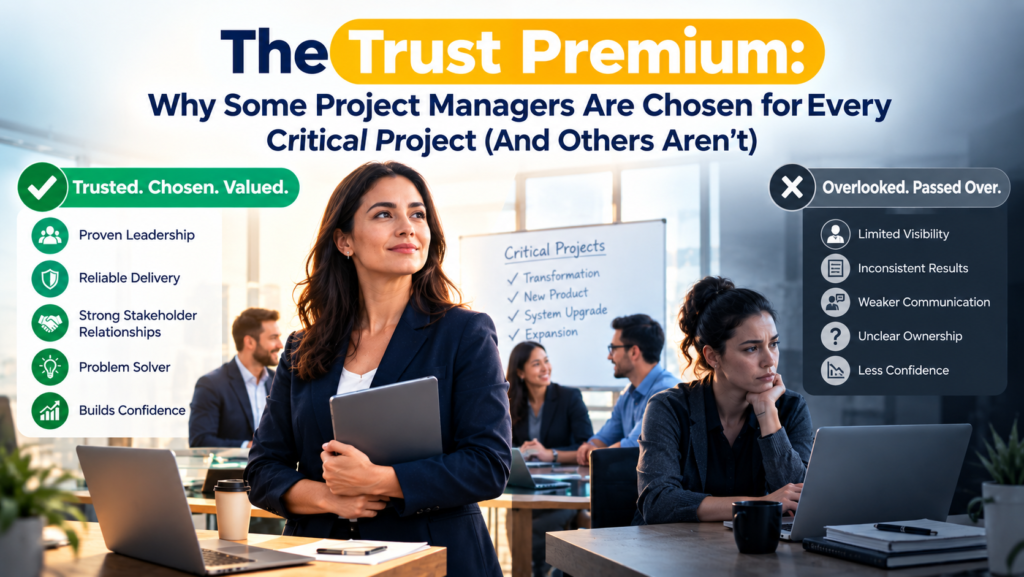

A trusted project manager is the person a sponsor calls first when the budget is tight, the deadline is fixed and the board is watching. Not the loudest voice in the room. Not necessarily the person with the longest list of letters after their name. Simply the one leaders believe will tell them the truth and still land the project.
If you have ever watched the same two or three people collect every high-profile project while equally capable colleagues get the leftovers, you have seen the trust premium at work. It is real, it shows up in promotions and pay, and the good news is that it can be built on purpose.
This guide explains what a trusted project manager does differently, why executives keep choosing them, and how you can build the same reputation in your own workplace, whether you are in Sydney, Melbourne, Brisbane, Perth, Adelaide or Canberra. You will also see which project management certifications help most and how to start.
What Is the Trust Premium for a Trusted Project Manager?
The trust premium is the extra opportunity, autonomy and pay that flows to project managers leaders consider a safe bet. Two people can hold the same title and the same qualifications. One is handed the ERP rollout, the regulatory deadline or the hospital fit-out. The other keeps getting small internal upgrades. The difference is rarely technical skill. It is confidence.
Look at it from the sponsor’s chair. A critical project is one where failure is expensive, public or both. Giving it to someone unproven puts the executive’s own reputation on the line. So they pick the person whose behaviour they can already predict. That is the whole premium: leaders spend less energy on doubt, so they hand over more responsibility.
Large-scale studies such as the Edelman Trust Barometer show that people back those they see as both competent and ethical. The same logic plays out inside organisations. And PMI’s Pulse of the Profession consistently points to leadership, communication and stakeholder engagement as what separates strong project teams from struggling ones. A trusted project manager sits right in the middle of all three.
Why Executives Keep Choosing the Same Few Project Managers
Executives are not really choosing a project manager. They are choosing a risk profile. When a decision-maker scans the shortlist for a critical project, they are quietly asking four questions:
- Will I be surprised? Predictable people get the big projects because surprises are what end careers.
- Will I hear about problems early? Bad news at week two is a conversation. Bad news at week twelve is a crisis.
- Will this person own the outcome? Leaders want someone who says “I’ll fix it”, not “the vendor let us down”.
- Will stakeholders respect them? A project manager without credibility spends half their energy asking for cooperation.
Notice that none of these is a software skill, and every one of them describes a trusted project manager. You can be brilliant at Microsoft Project, Jira or Smartsheet and still be passed over if leaders cannot tell how you will behave when things go sideways.
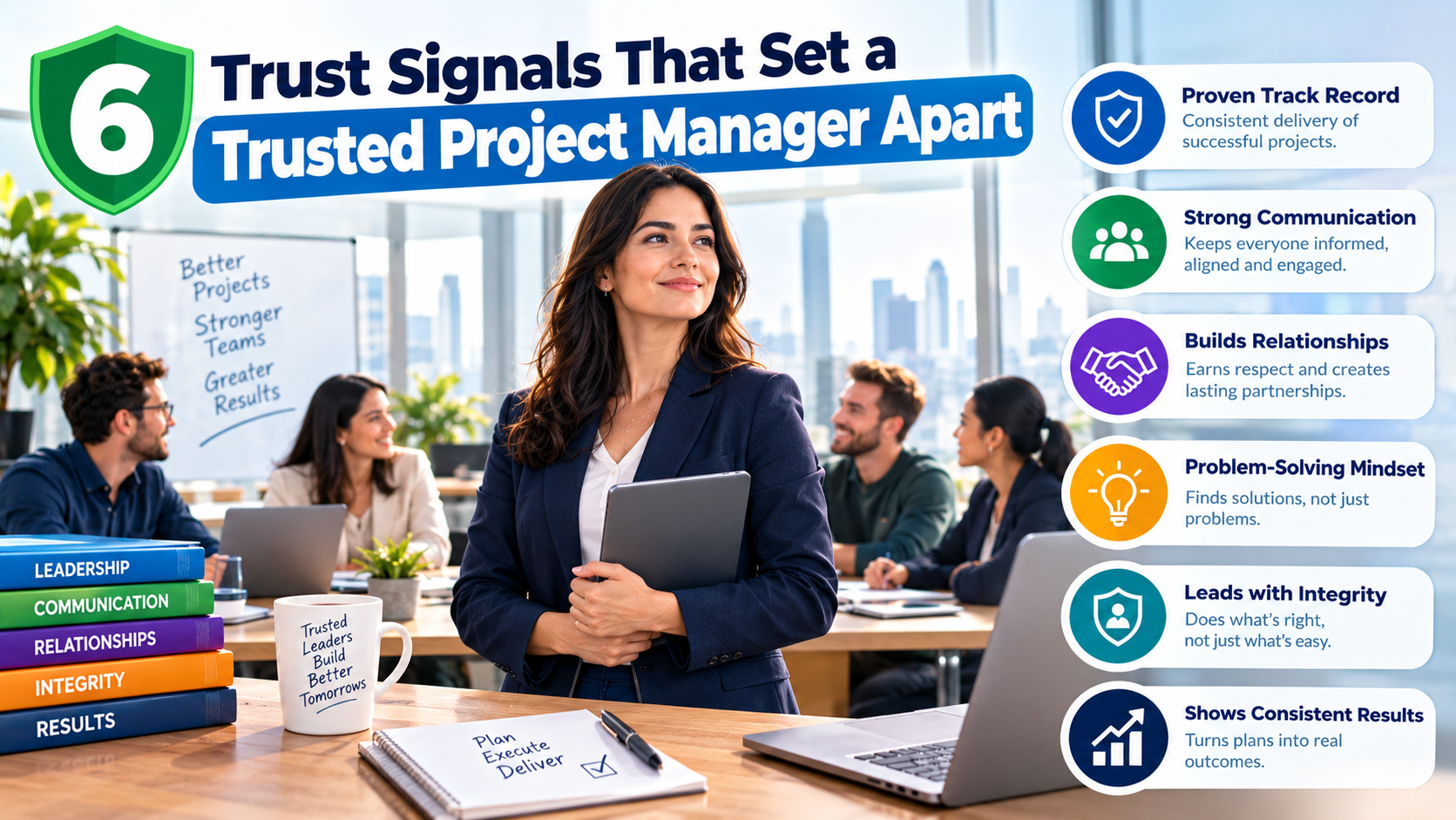
6 Trust Signals That Set a Trusted Project Manager Apart
1. They Deliver Bad News Early, With Options
Every project has a bad week. What leaders remember is when they heard about it. A trusted project manager raises the risk while it is still a small conversation, arrives with two options and a recommendation, and never lets a sponsor discover a slipped milestone in a steering committee meeting.
Here is what that sounds like in practice: “The vendor’s delivery has moved by two weeks. We can absorb it by resequencing testing, or add a contractor for three weeks. I recommend the first option, and here is the trade-off.” One short message, and the sponsor knows you are in control.
2. Their Estimates Hold Up
Trust is built on small predictions that come true. If your two-week estimates keep taking four, leaders stop believing your big numbers too. Reliable project managers track estimates against actuals, give ranges rather than false precision, and explain their assumptions. Sharpening those habits is exactly what the Project Planning & Control course is designed for.
3. They Protect the Team and Stay Accountable Upward
Teams trust project managers who absorb pressure instead of passing it down. Sponsors trust project managers who never hide behind the team. The people who get chosen for every critical project do both: they shield their people from noise and take full responsibility upward when something goes wrong.
4. They Make Decisions and Risks Visible
A simple decision log, a live RAID log (risks, assumptions, issues, dependencies) and a one-page status report do more for credibility than a beautiful Gantt chart nobody reads. When people can see what was decided, by whom and why, arguments shrink and confidence grows.
5. They Stay Steady Under Pressure
Nobody trusts a project manager who is calm on green weeks and frantic on red ones. Consistent tone, clear next steps and a habit of asking “what do we know, and what do we need to decide today?” make people feel safe, even when the news is bad.
6. They Invest in Their Craft
A certification does not create trust on its own, but it lowers the amount of proof leaders need before they back you. Frameworks such as PRINCE2, PMP and AgilePM give sponsors a shared language and a visible commitment to professional standards. We cover the options in the certification section below.
Trusted vs Overlooked Project Manager: Side-by-Side
| Situation | Trusted project manager | Overlooked project manager |
| Bad news | Raises it early with options and a recommendation | Waits until it is undeniable, or hopes it fixes itself |
| Status reports | Honest, short, decision-focused | Always green until suddenly red |
| Estimates | Ranges, assumptions and a track record | Single dates, optimistic by default |
| Stakeholders | Talks to them before they complain | Only engages when something is wrong |
| Accountability | Owns the outcome, credits the team | Blames vendors, scope or “the business” |
| Under pressure | Consistent tone, clear next steps | Reactive, changes direction daily |
| Learning | Certified, reflective, keeps skills current | Relies on experience alone |
What Quietly Costs Project Managers Trust
Most project managers who get passed over are not incompetent. They are simply leaking trust in small ways. Watch for these:
- Green status reports that turn red overnight
- Saying yes to every request to keep people happy, then missing dates
- Going quiet the moment a project gets difficult
- Blaming a team, supplier or department in front of senior leaders
- Focusing on activity (“we held 12 workshops”) instead of outcomes
- Ignoring the sponsor between steering committees
The fix is rarely dramatic. It is a run of small, boring, reliable behaviours that add up to a reputation.
How to Become a Trusted Project Manager: A 90-Day Plan
Days 1 to 30: Listen and Set the Baseline
- Book a short conversation with your sponsor and ask what “a good project” looks like to them.
- Start a decision log and a RAID log on your current project, even if nobody asked for one.
- Review your last five estimates against actuals and note where you were off and why.
Days 31 to 60: Prove Reliability
- Send a short weekly update at the same time every week, with one clear decision or risk in every message.
- Raise your next problem early, with two options. Watch how the conversation changes.
- Enrol in a foundation course such as PRINCE2 Foundation or CompTIA Project+ to add a recognised framework to your experience.
Days 61 to 90: Widen Your Visibility
- Offer to present the project outcome, lessons learned and benefits to a senior audience.
- Ask a stakeholder outside your usual circle for feedback on how you communicate.
- Volunteer for a stretch assignment, then apply for the next level, for example PRINCE2 Practitioner or PMP.
Do Certifications Help You Become a Trusted Project Manager?
Certification is a trust shortcut for any aspiring trusted project manager, not a trust substitute. It tells a hiring manager or sponsor that you understand recognised methods, and it gives them a reason to give you a chance before you have a long track record with them. Combined with honest reporting and reliable delivery, it is a powerful signal.
| Certification | What it signals to leaders | Best suited to |
| PRINCE2 Foundation and Practitioner | Structured governance, clear roles and controlled stages | Government, corporate and large programs |
| PRINCE2 Agile Foundation and Practitioner | Governance combined with agile flexibility | Digital and transformation projects |
| AgilePM Foundation and Practitioner | Practical agile delivery with project discipline | Software, product and change teams |
| PMP Certification | Globally recognised, experience-based credibility | IT, construction, consulting, engineering |
| CompTIA Project+ | Solid entry-level grounding in project fundamentals | Coordinators and aspiring project managers |
| BCS IS Project Management Foundation | Information systems project fundamentals | IT project teams |
| Project Planning & Control | Reliable scheduling, cost control and forecasting | Planners, schedulers, project managers |
Not sure which path fits? Compare options on our certifications page, browse the FAQs, or call 1300 649 299 to speak with a course advisor. You can also explore Logitrain’s full range of project management courses.
Trusted Project Manager Opportunities Across Australia
Every capital city rewards trust, though the industries that value it most differ. Here is where a trusted project manager tends to be in demand:
- Sydney: finance, technology, consulting and large-scale infrastructure programs.
- Melbourne: healthcare, construction, technology and professional services.
- Brisbane: major infrastructure and the long pipeline of projects linked to the 2032 Olympic and Paralympic Games.
- Perth: resources, energy and engineering projects.
- Adelaide: defence, advanced manufacturing and government.
- Canberra: federal government agencies, digital transformation and defence.
Wherever you are, live online and instructor-led training makes it easy to earn a recognised certification without stepping away from work. Learners in Hobart and Darwin can join live virtual classes as well.
Frequently Asked Questions About Becoming a Trusted Project Manager
What makes a trusted project manager?
A trusted project manager is someone leaders believe will report honestly, estimate realistically and stay calm when a project goes off track. Trust comes from repeated, visible behaviour: raising risks early, keeping promises, documenting decisions and taking ownership of outcomes. Technical skill matters, but it is the reliability that earns the next critical project.
How long does it take to become a trusted project manager?
There is no fixed timeline, but most people notice a shift after several months of consistent behaviour rather than a few weeks. Trust is built project by project. Delivering one small, well-communicated win for a senior stakeholder is often the fastest way to be considered for something bigger.
Do I need a certification to be seen as a trusted project manager?
No, but a recognised certification lowers the amount of proof leaders need before they back you. PRINCE2, PMP and AgilePM give employers a shared language and a credible signal of method. They work best when paired with a track record of honest reporting and delivery.
Which certification is best for leading critical projects in Australia?
It depends on your sector. PRINCE2 is widely used in government and large corporate environments, PMP is globally recognised and popular in IT, construction and consulting, and AgilePM or PRINCE2 Agile suit fast-moving digital work. Many senior project managers hold more than one. Speak to a course advisor about your industry before choosing.
Can a project coordinator become a trusted project manager?
Yes. Coordinators are often closer to the detail than anyone else, which is a strong starting point. The move usually comes from owning decisions, communicating directly with sponsors, taking a small project end to end and backing it up with a foundation certification such as PRINCE2 Foundation or CompTIA Project+.
Are online project management courses recognised by employers in Australia?
Yes. Live online and instructor-led courses lead to the same accredited exams as classroom delivery, and employers in Sydney, Melbourne, Brisbane, Perth, Adelaide and Canberra recognise the certification itself, not the delivery format.
Final Thoughts: Trust Is the Real Career Advantage
Every trusted project manager shares one trait: their word holds up. Chosen project managers are rarely the ones with the flashiest templates. They are the ones whose word holds up. If you want to be a trusted project manager, start with what you can control this week: report honestly, estimate carefully, own your outcomes and make your decisions visible. Then add a certification that gives leaders a recognised reason to say yes.
Ready to take the next step? Explore our project management certifications, see what is available in your city, or contact our team for personalised advice. Your next critical project could be closer than you think.